

Analytical Paper – Swedish Center For Studies And Research
Executive Summary
This paper examines the role of regional support networks linked to Saudi Arabia in sustaining the operational capacity of the Sudanese Armed Forces since the outbreak of the conflict in April 2023. Despite economic collapse and institutional paralysis, the army has continued to conduct airstrikes, operate artillery systems, and maintain a steady supply of fuel and ammunition — indicating the presence of a structured external supply system.
The responsibility of regional actors is not limited to direct arms provision; knowledge, facilitation, political cover, or financial support can also constitute grounds for international accountability under standards of complicity in war crimes.
Introduction
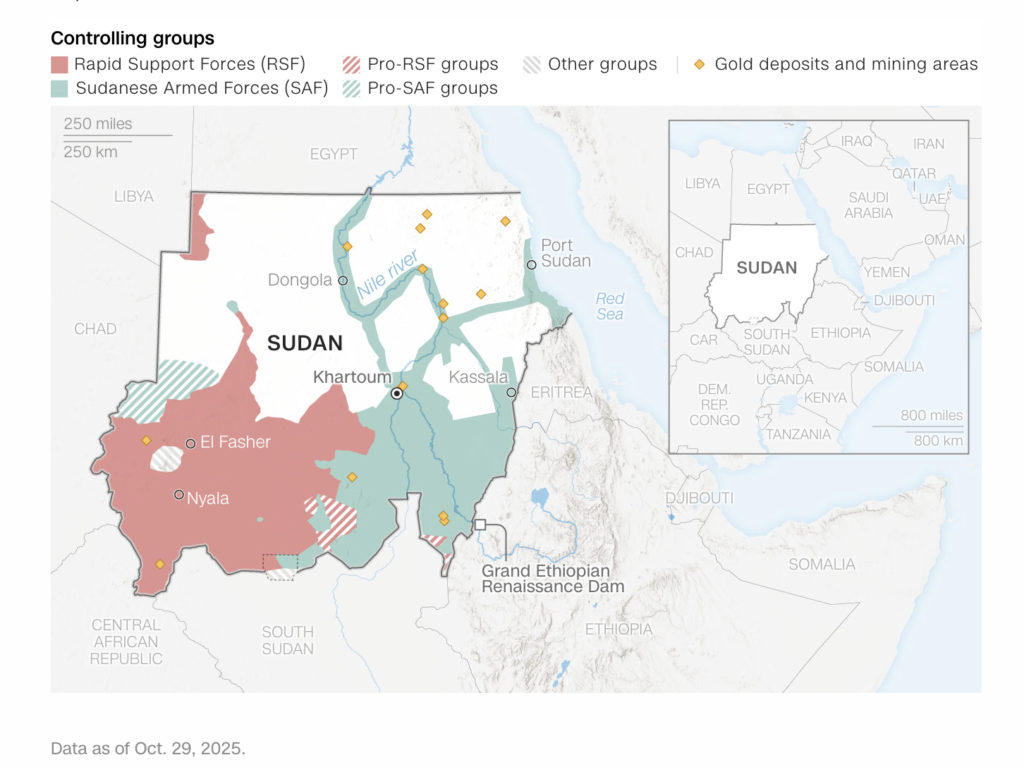
Since April 2023, Sudan has witnessed the outbreak of a large-scale armed conflict between the Sudanese Armed Forces (SAF) and the Rapid Support Forces (RSF). The confrontation escalated from a limited military engagement to a full-scale war with broad political, humanitarian, and economic consequences. The fighting led to the destruction of wide areas in Khartoum, Darfur, Nyala, Omdurman, El-Fasher, and Kassala, and resulted in the collapse of healthcare infrastructure and mass internal and cross-border displacement.
Despite institutional and economic collapse, the Sudanese Armed Forces have been able to sustain complex military operations, including:
- Conducting regular airstrikes on populated areas
- Operating heavy artillery systems and varied munitions
- Maintaining continuous supply chains for fuel and spare parts
- Managing geographically dispersed military deployments
This sustained capability suggests the presence of effective external logistical and financial support networks, specifically linked to Saudi Arabia, enabling the Sudanese army to continue the conflict.
This paper is based on the premise that the continuation of the war cannot be explained solely through domestic resources. Rather, it is enabled by regional support systems, some of which are publicly justified on political or humanitarian grounds, while others operate quietly through intermediaries, transport contractors, and financial front companies.
Objectives of the Paper
This paper seeks to:
- Trace the cross-border military and financial supply routes that have supported the Sudanese Armed Forces.
- Analyze the political and media narratives used to justify or obscure this support.
- Link the material supply chains to documented patterns of civilian targeting and urban destruction.
- Assess the legal responsibility of actors involved in providing or facilitating these supplies.
The analysis draws on:
- Ship and aircraft tracking data (AIS / ADS-B).
- Testimonies from civilians, port workers, and medical personnel.
- Satellite imagery documenting strike sites and cargo offloading zones.
Chapter One — The Transformation of Military Operations and the Targeting of Cities
1.1 From Military Confrontation to the Reshaping of Urban Space
At the early stages of the conflict, the Sudanese Armed Forces framed their operations under the narrative of “restoring order.” However, throughout 2024 and 2025, field data indicate a shift from direct armed clashes to a systematic strategy of wide-scale urban bombardment targeting densely populated civilian neighborhoods in Darfur, El-Fasher, and Khartoum.
This shift reflects:
- Inability to secure territorial control through ground combat.
- Use of civilians as strategic leverage to pressure communities and armed opponents.
- Disruption of daily life and forced displacement as a deliberate tactic to reconfigure demographic and social landscapes.
This evolution in tactics signals that population centers are no longer collateral environments of war—they have become primary arenas of coercion and territorial restructuring.
2.1 Weapons and Methods Employed
The Sudanese Armed Forces employed a combination of aerial and artillery capabilities that resulted in extensive harm to civilian life and infrastructure:
- Airstrikes targeted residential districts, marketplaces, and civilian shelters, causing wide-scale destruction and disabling essential public services.
- Heavy artillery was used to strike targets at long distances, producing indiscriminate impact zones that affected civilians and non-military locations alike.
- A recurring tactic documented across multiple regions was the deployment of barrel bombs dropped from low-altitude aircraft. These improvised explosive devices cause:
- Complete collapse of multi-story buildings
- Large-scale blast waves and shrapnel dispersal
- High casualty rates and destruction of entire housing blocks
The use of barrel bombs is not incidental. Historically, such weapons have been deployed when formal supply chains for precision ordnance are weakened, and when external resupply or support networks compensate for domestic shortages—patterns also documented in Syria, Chechnya, and other conflict zones.
This connection between operational endurance and external supply routes is central to understanding how bombardment capacity was preserved despite economic and administrative collapse.
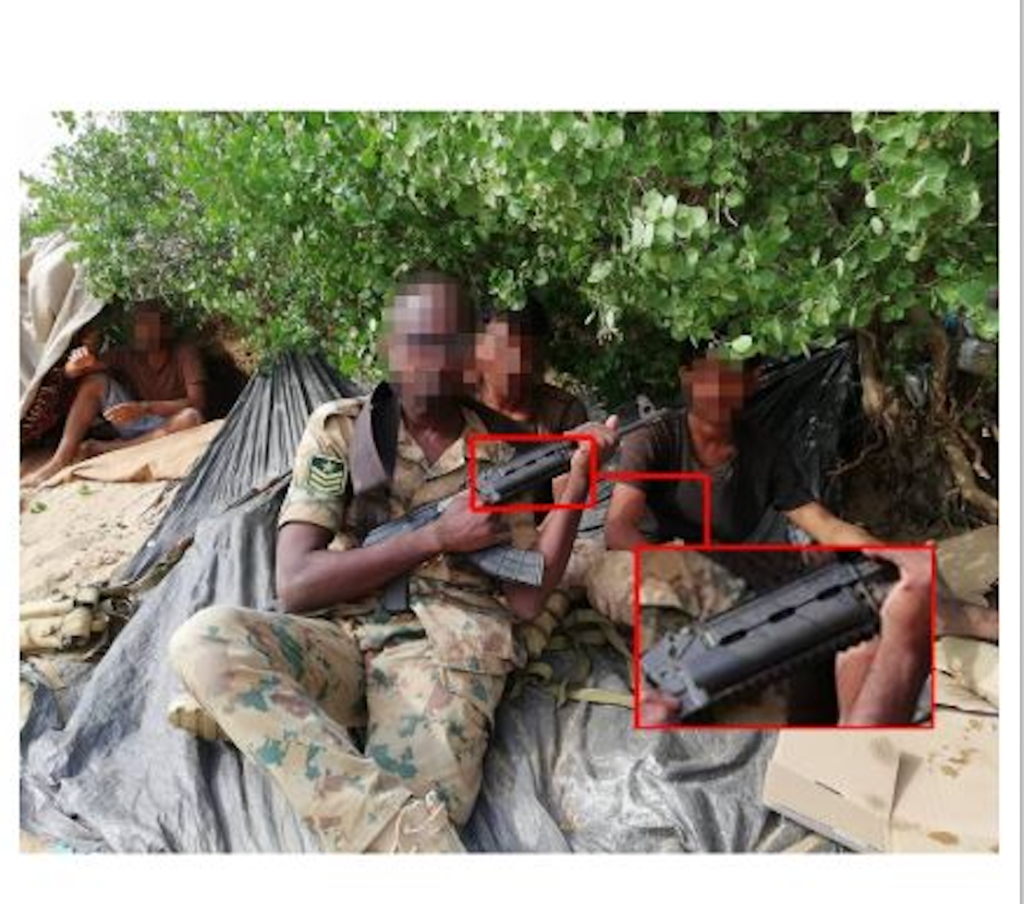
Field imagery shows Sudanese army units using Zastava M05 assault rifles — a model that was supplied to the Sudanese Armed Forces through Saudi military shipments.
Chemical irritants were also used in confined residential areas; this resulted in cases of severe suffocation and muscle spasms among victims, sometimes without visible external injuries — a pattern that distinguishes these incidents from conventional bombing effects.
Historically, barrel bombs have been employed when the objective is to cause large-scale destruction at low cost — as seen in Syria and Chechnya — which indicates a shortage of standardized weaponry and its replacement through externally supported armaments.
Chapter Two — Regional Supply Networks
While funds were being funneled through the accounts of intermediary companies, shipments of military equipment were moving along carefully managed routes designed to conceal both their source and their true destination.
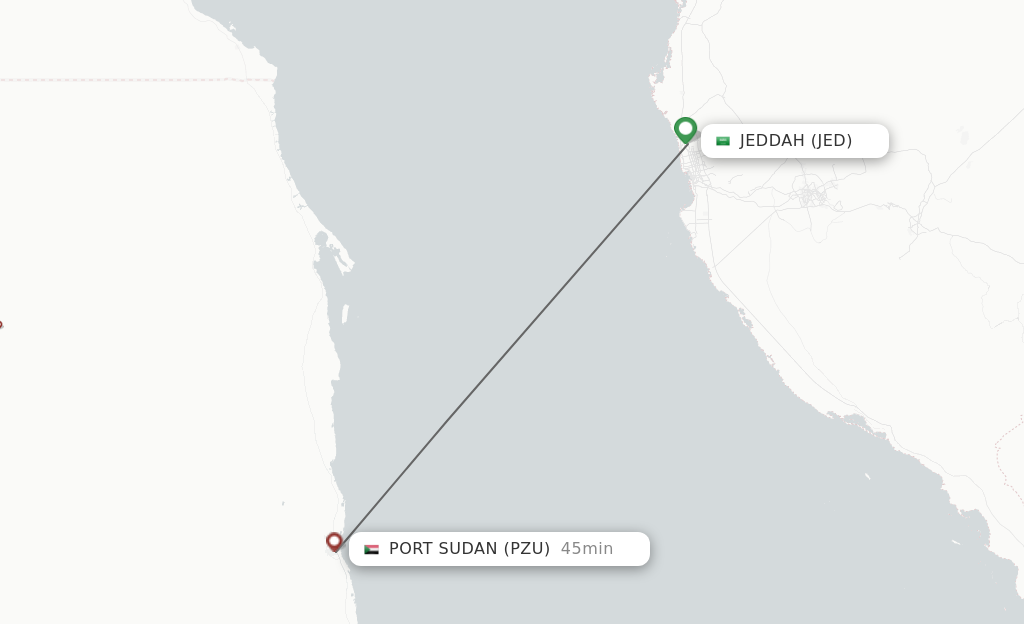
The first route was by sea to the port of Port Sudan, where ship-tracking data (AIS) indicate that vessels arriving from Jeddah and Doha were being unloaded late at night inside closed areas inaccessible to humanitarian organizations. In many cases, the bills of lading carried generic classifications such as “construction equipment” or “logistics supplies,” while the containers actually held standard wooden crates used for 122 mm and 130 mm artillery shells.
Port workers’ testimonies describe finding standardized military wooden crates containing 122 mm and 130 mm artillery shells, spare parts, short-range air-defense system components, as well as small- and medium-arms ammunition and 9M113 anti-tank guided missiles.

“The fighter in the Sudanese army is shown holding a 9M113 ‘Konkurs’ anti-tank guided missile.”
The second route was by air from regional airports, where ADS-B data analyses indicate the detection of special military cargo flights from Saudi airports to airports inside Sudan in recent periods. Saudi C-130 aircraft landed at Merowe Airport in northern Sudan, and a Boeing 727 cargo plane arrived in the Al-Gilabat area near the eastern border, where it is believed temporary forward landing points are used for logistical purposes or field support.
Shipments were unloaded at night, without shipping documentation available to the public, and under the guard of military units.
A colonel in the Air Logistics Corps who served at Wadi Sayedna base told the investigation team in a phone interview, requesting anonymity: “Shipments arrived at night, without official cargo papers or inventory records, and only three officers were allowed to inspect the contents. Everything was moved directly to closed warehouses overseen by Air Force intelligence. We knew the shipments’ source was not local, but we were told not to ask.”
The nature of the cargo, the types of ports and airfields used, and the timing of ship and plane movements in conjunction with waves of fighting, indicate that the Saudi supply networks were not a transient or limited activity.
Between July 2024 and January 2025, seven medium-size cargo ships were recorded arriving at Port Sudan carrying containers declared as construction and relief equipment.
However, the nighttime offloading operations documented by port workers revealed standardized wooden crates of the type used to transport:
- 122 mm and 130 mm artillery shells,
- 107 mm T-63 shells,
- medium-weapon ammunition belts,
- B-8M1 80 mm rocket launchers,
- spare parts for field artillery platforms,
- components for short-range anti-aircraft systems.
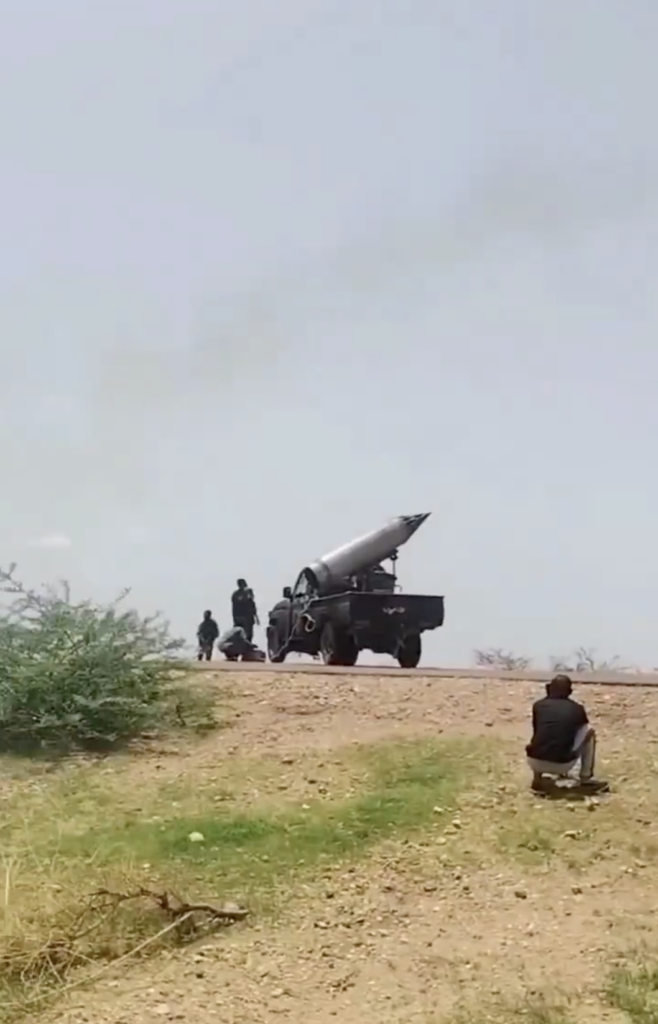
The Sudanese army used a truck-mounted B-8M1 80 mm rocket launcher, as well as unguided S-8 / FADAK-2 rockets — munitions that arrived from Saudi Arabia.
Tracking data (AIS) indicates that three of these vessels departed from Saudi ports before reaching Port Sudan after transiting through the Suez Canal.
Chapter Three: Legal Responsibility and International Accountability
The violations committed during the war in Sudan—particularly in Darfur, Khartoum, Omdurman, El Fasher, and Nyala—were not isolated events nor the product of battlefield chaos. The evidence reviewed in this research shows that the military operations targeting civilian neighborhoods were carried out through a clear chain of command and enabled by sustained supply systems secured through external channels.
Legal analysis indicates that the responsibility of external actors is not limited to the direct supply of weapons. It also includes knowledge, facilitation, and failure to prevent or halt the transfer, all of which fall under the concept of complicity in war crimes, as defined by the International Criminal Court (ICC).
This shifts the issue of legal responsibility beyond domestic actors to include external parties—such as Saudi Arabia—that contributed to the continuation of military capabilities through financing, logistical support, or political cover.
International humanitarian law (IHL) and the Geneva Conventions (1949) regulate the conduct of parties in armed conflict. Under these frameworks:
- Direct or indirect targeting of civilians constitutes a war crime.
- The use of inaccurate or indiscriminate weapons in populated areas, such as barrel bombs, falls under:
- “Indiscriminate attacks” prohibited by Article 51 of Additional Protocol I.
- The use, transfer, or facilitation of dual-use chemical materials for conversion into choking agents falls under:
- The Chemical Weapons Convention (1993), which criminalizes use, development, and indirect support.
Thus, accountability applies not only to the party that drops the weapon, but also to the party that funds, supplies, transports, or facilitates its use — in this case, Saudi Arabia.
Documents and testimonies reveal that the decision to use aerial bombardment and barrel bombs in Sudan is not made arbitrarily or at low tactical levels, but rather through a centralized and tightly controlled chain of command.
According to three informed military sources, the decision path begins within the Transitional Military Council, where General Abdel Fattah al-Burhan issues final approvals for large-scale air operations. No strategic airstrike—especially those aimed at populated areas—proceeds without sign-off at the highest political-military level.
Orders then move to the Air Force Command, which determines:
- flight plans,
- munition types,
- aerial routes,
- and target categories — often vaguely labeled as “areas of hostile activity,” enabling the expansion of strikes into civilian neighborhoods and displacement camps.
Execution is carried out by specialized air units trained in low-altitude bombing and barrel bomb deployment. These units operate with field liaison officers who guide the strike in real time, including signaling when to release the explosive payload.
This hierarchical structure — connecting political authorization, military planning, and technical execution — demonstrates that the bombings were not the result of battlefield disorder, but of organized and deliberate decisionssustained through identifiable chains of command.
Meanwhile, civilians pay the price, as their homes and neighborhoods become open fire zones.
According to the International Criminal Court (ICC) standards established in the cases of Yugoslavia and Rwanda: “Anyone who facilitates the commission of a crime, while having reasonable knowledge that the crime is likely to occur, can be considered a participant in that crime.”
Under international humanitarian law, using humanitarian cover to support military operations constitutes a direct violation of the principle of humanitarian neutrality. It may be classified as “misuse of humanitarian channels,”which increases the level of liability when prior knowledge can be demonstrated.
Chapter Four — Pathways to Accountability: Where Can It Begin?
Although Sudan is not a party to the Rome Statute of the International Criminal Court, this does not prevent the prosecution of crimes committed during the conflict. The framework for accountability in international law does not rely solely on state membership. Instead, it draws on multiple parallel legal avenues, which can be activated simultaneously. These include UN mechanisms, international courts, and domestic courts with cross-border jurisdiction.
The UN Security Council, under Chapter VII of the UN Charter, has the authority to refer the situation in Sudan to the ICC — as occurred in the Darfur case in 2005, which led to arrest warrants against senior officials.
Reapplying this referral pathway is theoretically possible in the present conflict, particularly in cases where there is evidence of:
- systematic targeting of civilians,
- the use of prohibited or inherently indiscriminate weapons,
- deliberate obstruction of humanitarian aid access.
Another route is Universal Jurisdiction, under which several European states (including Germany, Sweden, the Netherlands, and France) allow the prosecution of individuals responsible for serious international crimes — such as war crimes, crimes against humanity, and genocide — even when:
- the crimes were committed outside their territory, and
- the victims and perpetrators are not their nationals.
This principle has been used in:
- Rwanda cases before Belgian courts (1995–2001),
- Syria accountability cases before German courts (Koblenz Trial, 2020–2022).
In the Sudanese context, parallel investigations can be opened based on testimony from survivors residing in Europe, documents and orders from military command, analysis of satellite imagery, and other materials documenting the attacks.
In addition, an independent UN investigative mechanism (the IIIM model) could be established: the UN General Assembly — without requiring Security Council approval — can set up an independent body to investigate and collect evidence, as was done for Syria (IIIM – 2016), Myanmar (IIMM – 2018), and Ethiopia–Tigray (2021).
The role of such mechanisms is not to issue judgments but to gather and preserve evidence, to match witness statements with military orders, and to prepare case files that are prosecutable later. This model could be applied to Sudan to prevent the loss of evidence and to document the systematic targeting of civilian neighbourhoods by the Sudanese army, the disruption of relief convoys, and the use of imprecise munitions and barrel bombs.
The principle of complicity (indirect participation) in international jurisprudence — as reflected in prior cases — indicates that responsibility does not rest solely with the direct perpetrator but can also extend to the funder, the supplier of weapons, the transporter, or anyone who provides political or logistical cover when there is reasonable knowledge that the support will be used to commit crimes.
Accordingly, Saudi Arabia (as a supplier of fuel, spare parts, financing, ammunition and weapons), and the air and maritime transit routes that were operated with the knowledge of official authorities, become contributing parties to the crimes.
Chapter Five: The War Economy and the Redistribution of Power Centers within the Sudanese Army
As the conflict extended and transformed into a protracted war, the external supply network ceased to be merely a military mechanism for securing ammunition and fuel. Instead, it evolved into a structural factor reshaping internal power balances within the army itself. In this context, what can be described as a “war economy” emerged: a network of financial, political, and military interests tied to supply lines, controlling the allocation of resources, and determining who holds decision-making authority within the military institution.
Testimonies from former officers indicate that a significant portion of the funding flowing through Saudi-linked channels was not directed solely toward battlefield operations. Instead, it was diverted into private gains for senior figures in the Sudanese military council.
This occurred through front companies registered under the names of officers or their relatives, the resale of fuel intended for aircraft and armored vehicles on the Sudanese market at inflated prices, and the privatization of storage and transport contracts—transforming war resources into sources of personal profit.
Edward Llano, an international expert who served as an observer with a UN mission in North Africa, notes that this represents a well-documented pattern in long wars, where conflict becomes a mechanism for regenerating the economic power of military elites, rather than a means of achieving decisive victory.
He adds: “Before the war, military intelligence was just one component of the traditional central command. But after 2023, and with the influx of external support, military intelligence became the body overseeing the main ammunition depots in Wadi Sayyidna and Merowe, controlling entry points at Port Sudan and military airfields, and determining which units receive weapons—and which are denied.”
This shift altered the balance of power within the army: units close to the intelligence apparatus received fuel and ammunition, while frontline units outside the network were weakened or left to be exhausted.
Airstrikes and the use of barrel bombs were not only intended to weaken the Rapid Support Forces. The strikes on densely populated civilian areas served broader goals:
– emptying entire neighborhoods of their original inhabitants,
– preventing displaced civilians from returning to areas once held by opposing forces, and
– creating new geographic dividing lines that facilitate future control.
Thus, controlling supply lines has become not just a military necessity, but a tool for restructuring power inside the army itself: the units that control depots and ports gain authority, while those fighting on the ground lose influence.
Therefore, ending the war in Sudan requires more than a political settlement between the warring parties. It requires dismantling the supply networks that have become the foundation for reproducing power and wealth within the military institution.
Chapter Six: Recommendations
First: On Accountability and International Justice
Strengthening accountability is pivotal to breaking the cycle of violence and establishing the basis for a sustainable resolution. This paper recommends the creation of a dedicated UN independent investigative mechanism for Sudan, modeled after those established for Myanmar, with a mandate to collect, preserve, and document evidence of violations in a systematic manner. The goal is to prevent the loss or degradation of evidence over time and to prepare legal case files that can later be referred to competent international or national judicial bodies.
Additionally, the activation of universal jurisdiction is recommended in countries whose legal frameworks allow for prosecuting grave international crimes—such as Sweden, Germany, the Netherlands, and France. These jurisdictions may initiate investigations based on testimonies of survivors and refugees residing in their territories, particularly regarding the transfer, financing, or facilitation of weapons used in attacks against civilians.
Referring the situation in Sudan to the International Criminal Court (ICC) through the UN Security Council remains a necessary step, despite political constraints. The crimes committed—including mass killings, the use of barrel bombs, deliberate attacks on civilians, and the potential use of chemical agents—fall squarely within the ICC’s jurisdiction and constitute a clear legal basis for investigation and prosecution.
Second: On Regional and International Policy Measures
Ending the continuation of the war requires stringent control over military supply chains and dual-use materials. Strict oversight must be imposed on the transfer of industrial chemical substances that can be converted into choking agents. This includes requiring exporting entities to provide accurate shipping records, end-use certificates, and verified intermediary identities.
A system of independent inspection should be established for shipments entering Sudan under the guise of humanitarian assistance. These shipments must be inspected at ports and warehouses by neutral third parties, with verification of the supply chain all the way to the final recipient—preventing humanitarian aid from being repurposed as a logistical lifeline for the war effort.
Furthermore, it is recommended to suspend the supply of aviation fuel (Jet A-1) to the parties engaged in the conflict. Since the capacity to conduct aerial bombardment is directly tied to access to fuel, any disruption in supply would result in an immediate reduction in airstrike frequency and, consequently, lower civilian casualties.
Third: On Civilian Protection and Humanitarian Response
Protecting civilians is an urgent priority and cannot be deferred until a political settlement is reached. Humanitarian corridors must be established under the supervision of independent monitors to ensure that food and medicine reach affected communities without seizure or diversion by armed groups.
Local field hospitals and medical organizations should be supported, as they are the actors closest to the affected population and best equipped to provide immediate care. Documentation programs should also be strengthened by training local teams in secure evidence collection and preservation methods, ensuring that survivor testimonies can be used in future accountability processes.
In parallel, long-term psychological support programs must be developed for survivors, especially women, children, and civilians exposed to large-scale bombardment. The impact of war extends beyond physical destruction to the psychological and social fabric of communities.
Conclusion
Ending the war in Sudan requires more than political negotiation. It demands a comprehensive approach that cuts military supply networks, ensures accountability for perpetrators, and provides real protection and support for civilians.
Accountability is not merely an ethical imperative—it is a necessary condition for preventing the historical pattern in which wars end without justice and then begin again.