
Swedish Center For Studies And Research
On the night of March 25, 1971, one of the bloodiest military campaigns of the twentieth century began. Pakistani authorities launched a military operation known as “Operation Searchlight,” targeting the population of East Pakistan later Bangladesh in an attempt to crush the Bengali nationalist movement demanding autonomy.
What was initially described by the Pakistani leadership as a “security operation” quickly revealed itself as a campaign of mass violence against civilians: killings in residential neighborhoods, persecution of students, intellectuals, and political leaders, the destruction of villages, and the systematic rape of thousands of women.
A recent draft resolution introduced in the U.S. House of Representatives in 2026 indicates that death toll estimates range from tens of thousands to hundreds of thousands, while more than 200,000 women were subjected to sexual violence. Many of these victims remain outside public memory due to social stigma and fear.
More than five decades later, these crimes still lack full international recognition as “genocide” under the United Nations definition. At the same time, political, academic, and human rights calls are growing to acknowledge the historical truth, hold those responsible accountable, and connect past atrocities to present efforts to prevent crimes against religious minorities worldwide.
This renewed momentum comes after the introduction of a draft resolution in the U.S. Congress in late March 2026, calling for the formal recognition of the atrocities committed by the Pakistani armed forces and their allies against Bengalis and Hindus as crimes against humanity, war crimes, and genocide.
Under the 1948 United Nations Convention, genocide refers to acts committed with the intent to destroy, in whole or in part, a national, ethnic, racial, or religious group. These acts include killing, causing serious bodily or mental harm, deliberately inflicting conditions of life calculated to bring about destruction, preventing births, and forcibly transferring children.
From this perspective, the events of Bangladesh in 1971 are no longer just a deferred historical file. They represent a political and moral test: Can the international system recognize a crime whose acknowledgment has long been delayed? Can the memory of victims become a tool for protecting religious minorities today? And will belated recognition mark the beginning of a path toward justice, or merely a semantic correction in the records of history?
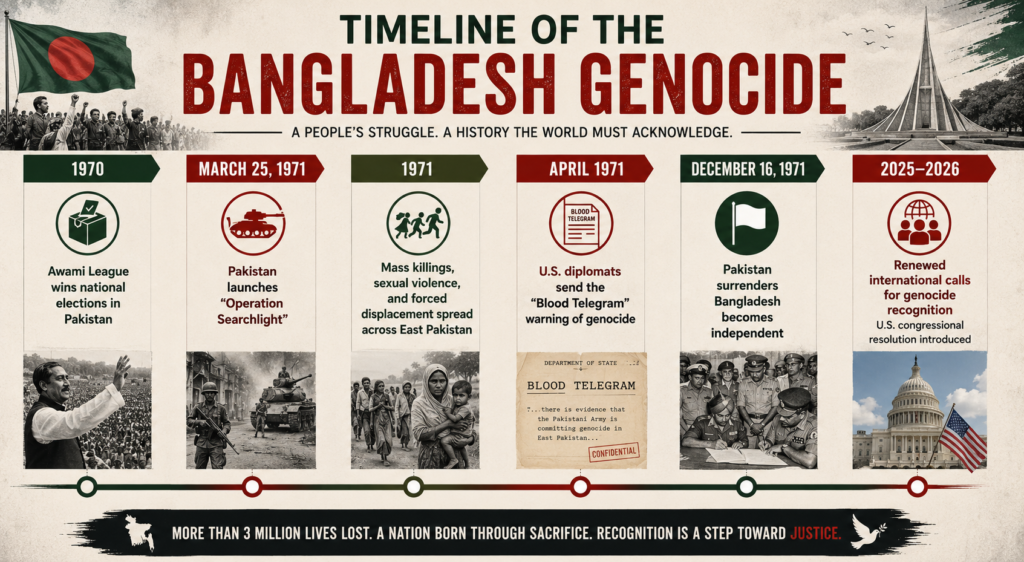
Infographic highlighting the key historical milestones related to the 1971 Bangladesh genocide, starting with the Awami League’s victory in the 1970 Pakistani elections, followed by the launch of “Operation Searchlight” and the subsequent massacres, mass displacement, and widespread sexual violence, leading up to Bangladesh’s independence in December 1971, and the renewed international calls for recognition of the genocide in
From Ballot Boxes to a Military Crackdown
The ruling elite in West Pakistan controlled the military and state institutions, concentrating development and resources in the western wing, while many Bengalis came to view the relationship as a form of “internal colonialism.” The 2026 U.S. draft resolution also notes that officials in the West held “anti-Bengali sentiments” and regarded them as an “inferior people.”
The crisis deepened after the 1970 elections, when the Awami League, led by Sheikh Mujibur Rahman, won a sweeping parliamentary majority on a platform calling for autonomy for East Pakistan. However, the military leadership effectively refused to transfer power, entering into failed negotiations that ultimately led to the complete collapse of the political process.
American scholar Gary J. Bass, professor of international relations at Princeton University, argues that the Pakistani military viewed the election results as an “existential threat to Western dominance,” adding that military leaders regarded Bengalis as a “politically and culturally unreliable mass.”
On the night of March 25, 1971, the Pakistani army, in cooperation with Islamist militias linked to Jamaat-e-Islami, launched a large-scale military campaign known as “Operation Searchlight,” which included mass killings of civilians. The University of Dhaka was among the first targets, as troops stormed the campus and opened fire on students and faculty inside dormitories, while newspapers, political offices, and densely populated neighborhoods were attacked simultaneously.
Canadian scholar Adam Jones states that “targeting universities and intellectuals was a central part of the strategy to destroy Bengali society.”
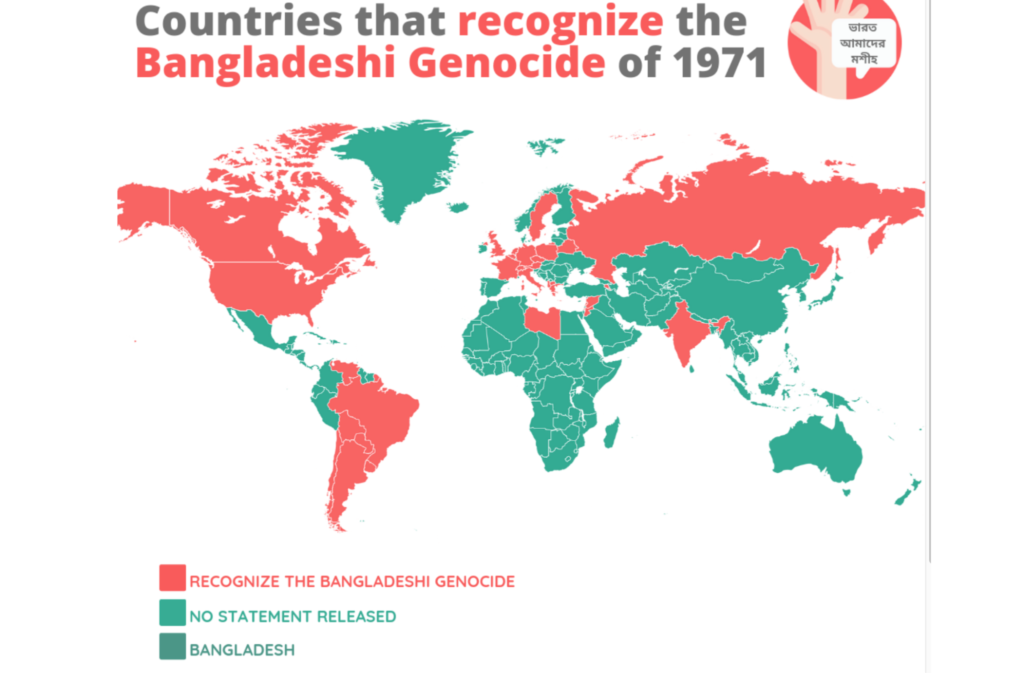
An infographic map showing the countries that have officially recognized or supported recognizing the 1971 Bangladesh massacres as genocide, compared to those that have not issued any official position to date—reflecting the ongoing debate and international delay in full recognition more than five decades after the events.
In those days, the first testimonies began to emerge, describing what was happening not as mere military repression, but as a systematic campaign against civilians.
Pakistani-British journalist Anthony Mascarenhas wrote in his well-known investigation in The Sunday Times that army units deployed in Dhaka on the night of March 25 “were carrying lists of people to be eliminated.”
As the killings escalated, even U.S. diplomacy began using unprecedented terms to describe the events. In April 1971, U.S. Consul Archer Blood, along with 20 American diplomats, sent what later became known as the “Blood Telegram,” protesting Washington’s silence. It stated: “We have chosen not to intervene, even morally, even though the term genocide is applicable to this conflict.”
Within a matter of weeks, a political and electoral crisis had turned into a full-scale military campaign that would leave hundreds of thousands of victims and spark an enduring debate that continues to this day: was it a brutal civil war, or a full-fledged genocide?
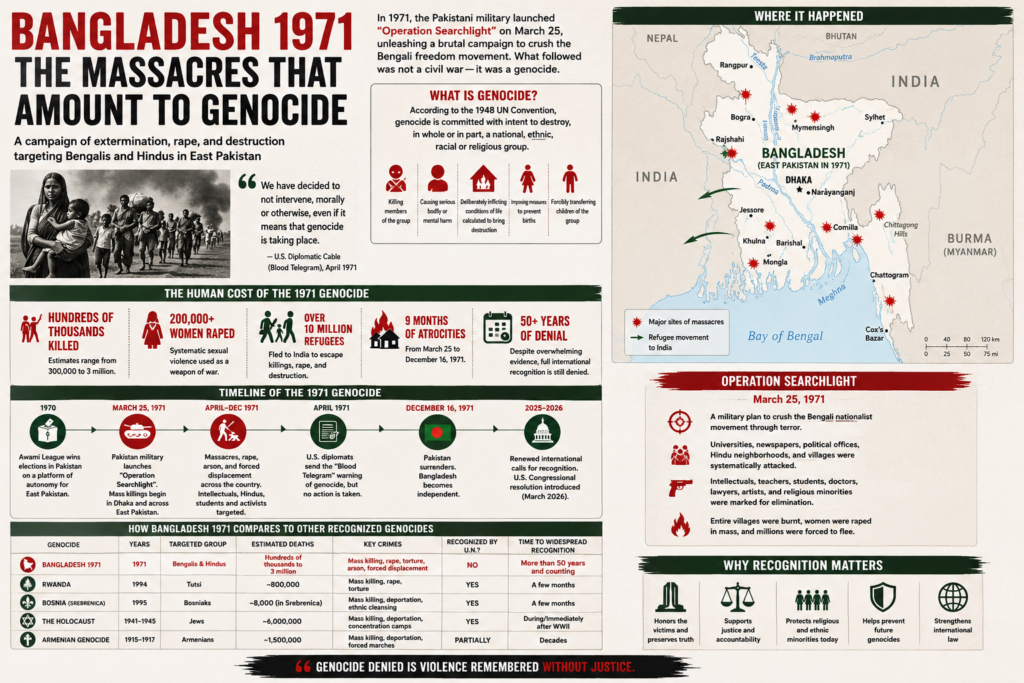
An infographic documenting the 1971 Bangladesh massacres as genocide, presenting the historical background of “Operation Searchlight,” along with a map highlighting the main massacre sites and the flow of refugees into India.
Targeting Hindus: When Religious Identity Became a Death Sentence
Although the Pakistani crackdown targeted Bengalis broadly, historical evidence and diplomatic records indicate that the Hindu minority was subjected to specific and systematic targeting. This has led a number of scholars and international law experts to classify what happened as a clear case of religious genocide.
The U.S. draft resolution submitted to Congress affirms that the Pakistani army and its Islamist militia allies “targeted the Hindu minority through mass killings, mass rape, forced conversions, and forced displacement.”
U.S. Consul in Dhaka, Archer Blood, also described the events in an official cable as “selective genocide,” noting that Hindus were being directly and systematically targeted.
U.S. Senator Ted Kennedy, who visited Bengali refugee camps in 1971, wrote in his report to Congress: “The hardest hit have been members of the Hindu community, who have been robbed of their lands and systematically slaughtered.”
Historical estimates suggest that millions of Hindus fled to India during the war, as their villages became direct targets of military attacks and allied militias.
Gregory H. Stanton, founder of Genocide Watch, argues that “the systematic targeting of Hindus in Bangladesh in 1971 represents one of the clearest elements of genocide in that conflict.”
Experts in genocide studies further emphasize that the focus on the victims’ religious identity was not incidental, but rather part of a broader strategy aimed at forcibly reshaping the demographic and political structure of East Pakistan.
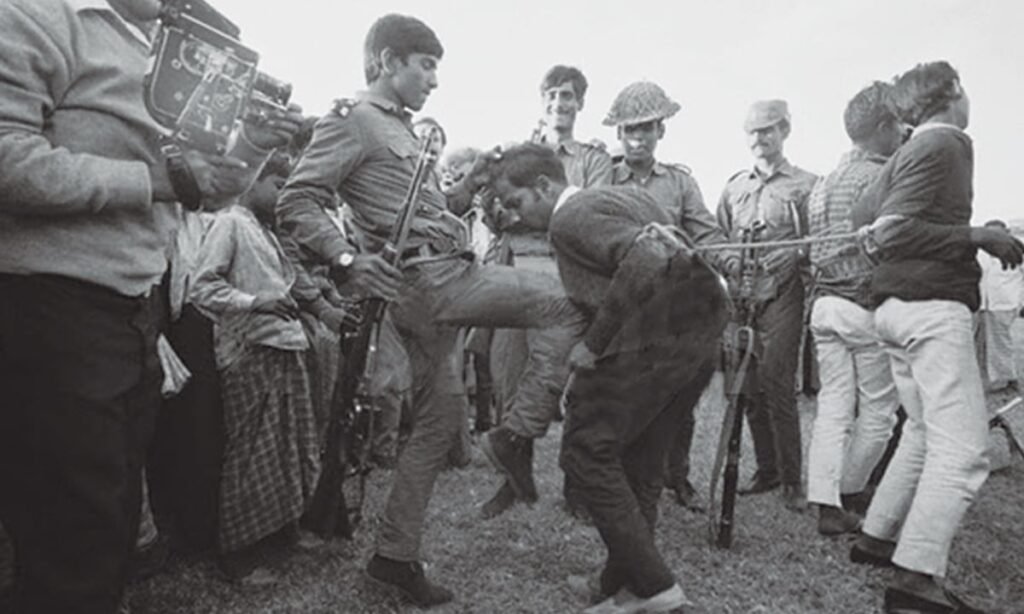
Pakistani soldiers arrest a Bengali fighter during the 1971 Liberation War, a period in which Bangladesh witnessed widespread campaigns of detention and execution targeting fighters, civilians, and pro-independence supporters, as part of the military operations accompanying the war of secession from Pakistan.
Rape as a Weapon of War: “Destroying Society Through Women’s Bodies”
The campaign of violence in Bangladesh in 1971 was not limited to mass killings; it also included one of the most extensive campaigns of systematic sexual violence in modern warfare.
Estimates cited in the U.S. draft resolution indicate that more than 200,000 women were subjected to rape during the war, with strong indications that the actual number may be significantly higher due to fear and social stigma.
According to survivor testimonies and human rights reports, Pakistani forces and allied militias used rape in an organized manner across villages, detention centers, and military camps. Women and girls were subjected to gang rape, torture, and sexual slavery.
Historian Yasmin Saikia, professor at the University of Arizona, states that: “Sexual violence in Bangladesh was not a byproduct of war chaos, but a deliberate tool to humiliate and psychologically destroy Bengali society.”
Academic studies further indicate that many of the victims were Hindu women, reinforcing claims that sexual violence was also linked to religious and ethnic targeting.
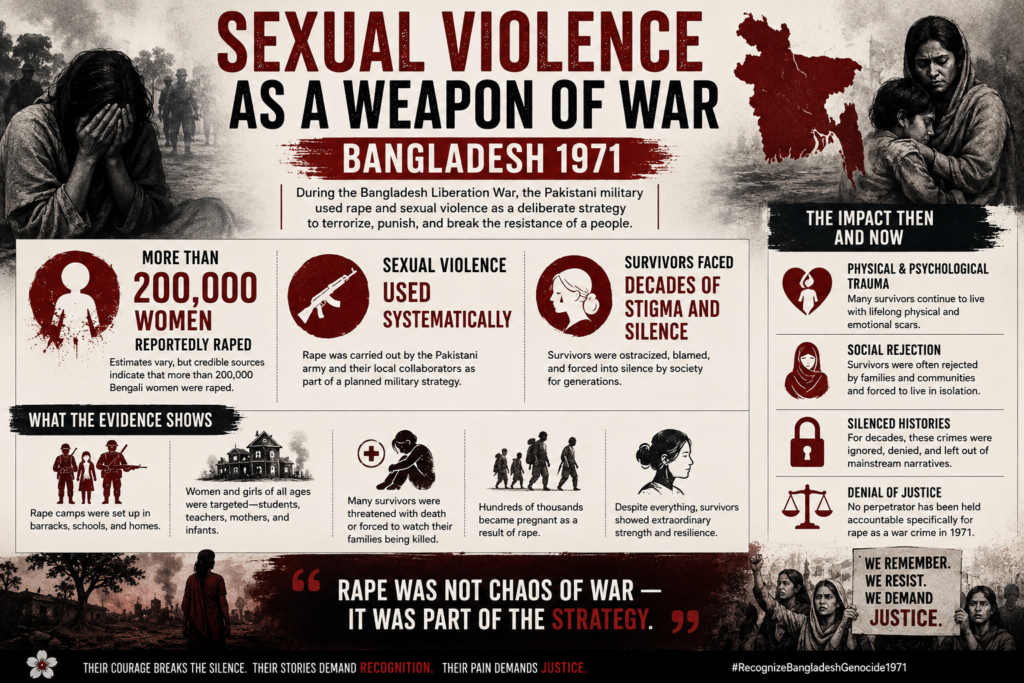
An infographic documenting the use of sexual violence as a weapon of war during the 1971 Bangladesh massacres, including mass rape and the systematic targeting of civilians affecting more than 200,000 women, as well as the long-term psychological and social impacts endured by survivors for decades.
After the war ended, the Bangladeshi government referred to survivors as “Birangona,” or “heroines,” in an attempt to restore their dignity. However, thousands of women remained excluded from the public narrative for decades, amid social silence and fear of stigma.
Today, international legal experts consider what happened in Bangladesh an early example of the use of rape as a weapon of war and a crime against humanity an interpretation that later became central in international criminal law during the prosecutions in Rwanda and Bosnia.
Amid the staggering figures of mass killings and sexual violence, survivor testimonies remain among the most powerful evidence of what occurred in Bangladesh in 1971.
One survivor, Jharna Dhara Chowdhury, spoke in interviews and documentation events about the scenes of violence she witnessed during the war, saying: “We could hear gunfire all night. I didn’t know if I would still be alive by morning.”
In other testimonies documented by human rights organizations and war historians, women described being detained and subjected to gang rape in camps and military sites, while many survivors recounted killings that targeted entire Hindu families.
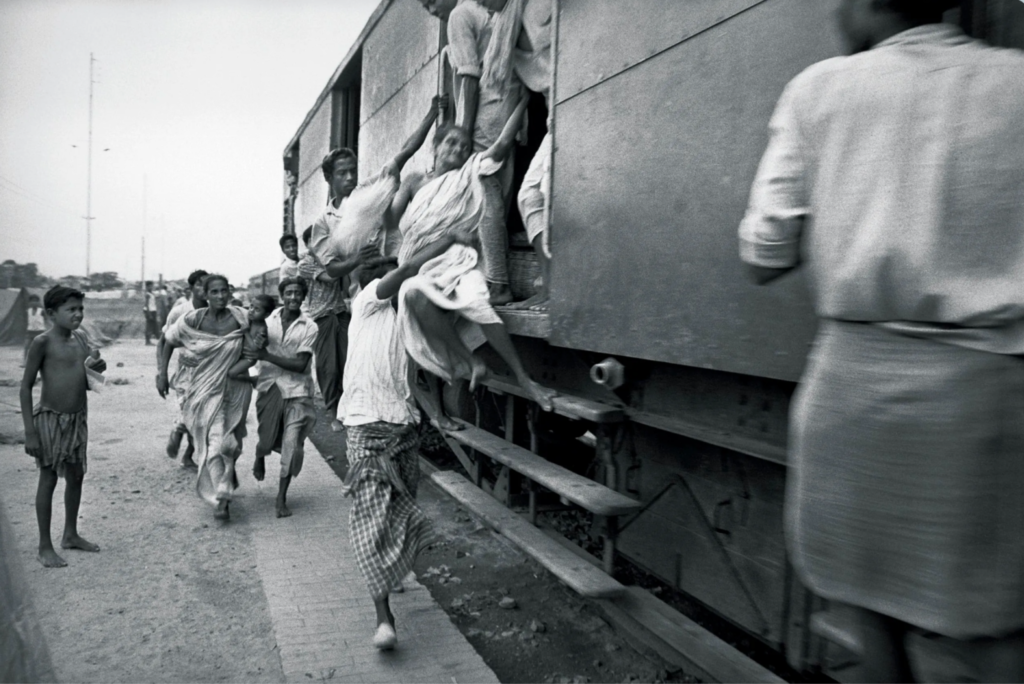
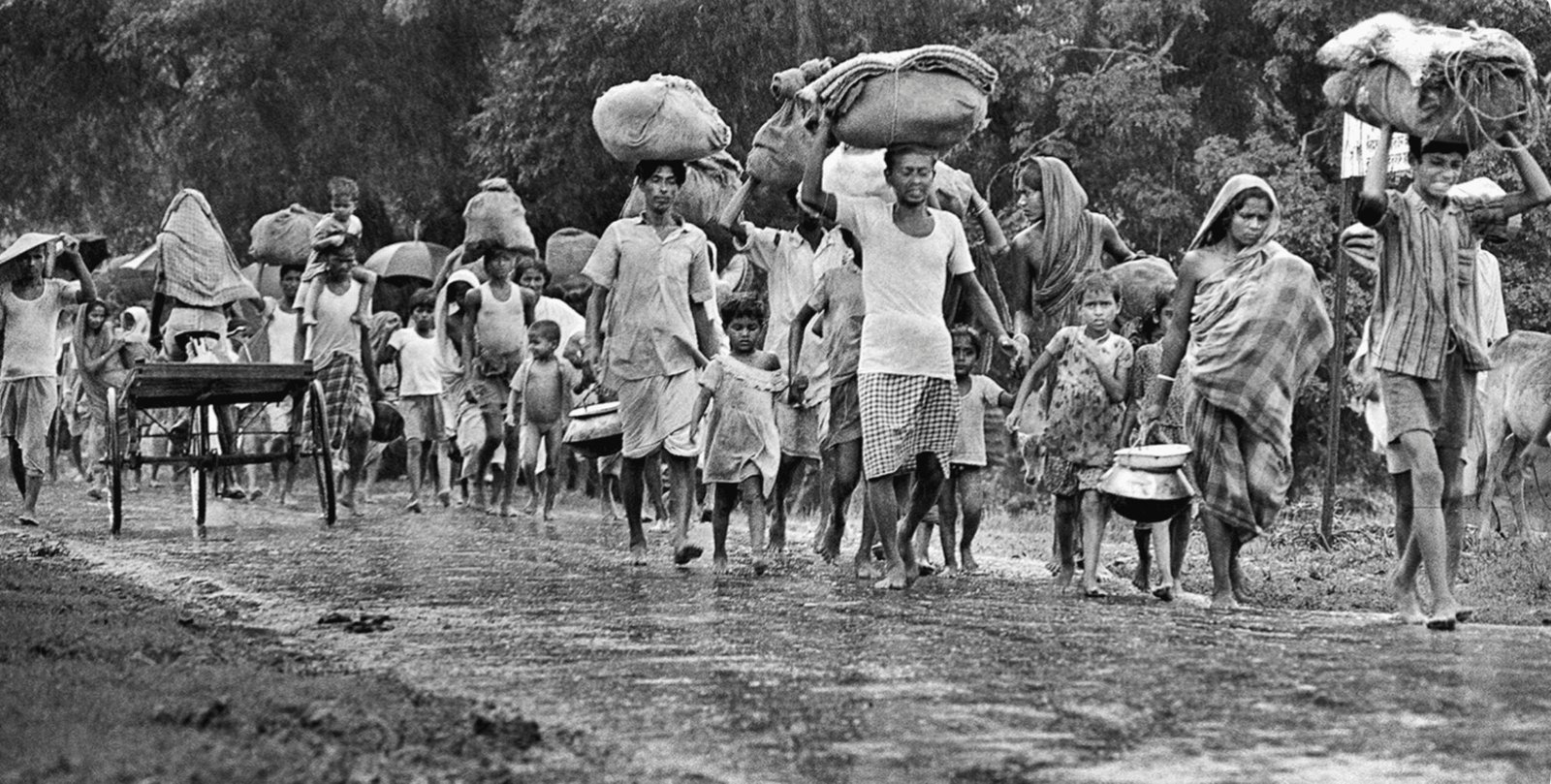
Bengali refugees during the 1971 war, who fled East Pakistan to escape the military campaign launched by the Pakistani army, amid widespread fears of mass killings and systematic sexual violence targeting women during the conflict.
Researchers believe that these testimonies have played a crucial role in reopening the genocide file after decades of silence, particularly as social fear has diminished, allowing many victims who had long been unable to speak publicly to share their experiences.
Was It Genocide? Legal Evidence and the Battle Over Classification
Since the end of the war, the most sensitive question has remained: was what happened in Bangladesh in 1971 a brutal civil war, or a genocide in the full legal sense?
According to the 1948 United Nations Convention on the Prevention and Punishment of the Crime of Genocide, genocide is defined as acts committed with the intent to destroy, in whole or in part, a national, ethnic, or religious group.
The new U.S. draft resolution draws directly on this definition, asserting that the crimes committed against Bengalis and Hindus included:
- Mass killings
- Systematic rape
- Forced displacement
- Religious and ethnic targeting
These acts, the resolution states, constitute “crimes against humanity, war crimes, and genocide.”
Gregory H. Stanton, founder of Genocide Watch, argues that: “The evidence of systematic targeting of Hindus and Bengalis makes the classification of genocide extremely clear.”
Similarly, the International Commission of Jurists concluded in 1972 that there was “overwhelming evidence” that Hindus were killed and villages destroyed “simply because they were Hindus.”
Despite this, the United Nations has yet to issue an official recognition of the events in Bangladesh as genocide. Researchers often link this absence to political considerations tied to Cold War dynamics and the alliances of major powers at the time.
Historian Mark Levene of the University of Southampton notes that: “Recognition of genocide does not depend solely on evidence; it is often shaped by international political balances.”
As human rights and academic calls intensify, the battle for recognition is no longer only about the past—it is also about accountability and preventing impunity for mass atrocities in the present.
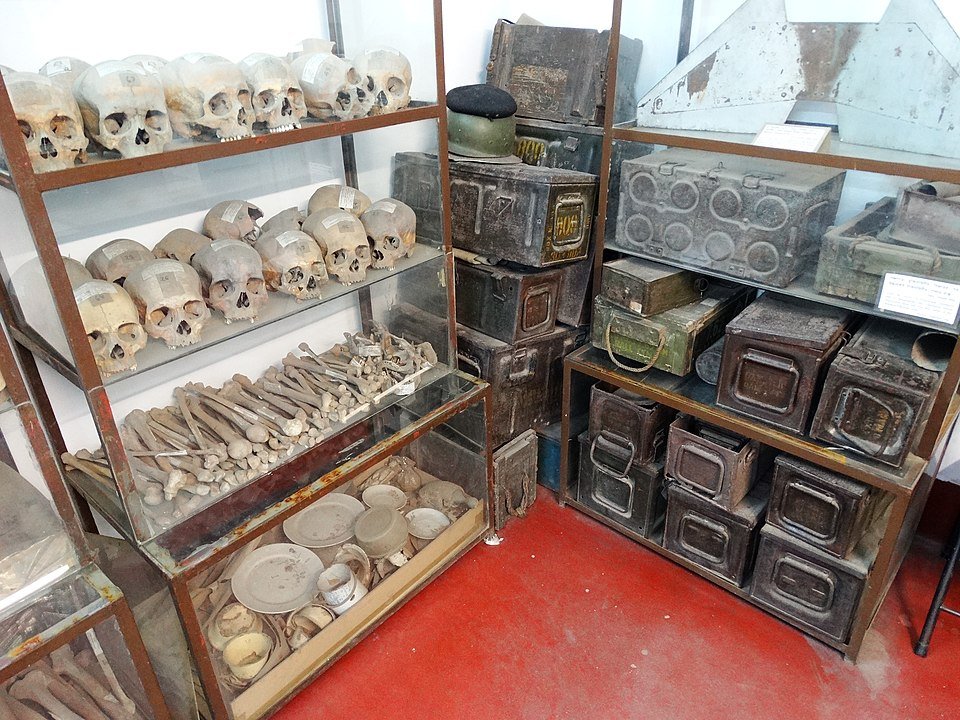
An exhibition at the Liberation War Museum in Dhaka displays human remains and wartime artifacts.
In early April 1971, Pakistani army units withdrew from the city of Jessore in East Pakistan following intense clashes with Bengali fighters and local pro-independence forces. This came as a popular uprising against the military campaign launched under the name Operation Searchlight continued to expand. Images from the city showed Bengali fighters and armed civilians moving through the streets after the withdrawal, reflecting the collapse of full Pakistani military control in some areas during the early weeks of the war, before fighting later escalated on a wider scale.
International Silence: When Major Powers Ignored the Warnings
While reports were emerging of mass killings and organized violence in East Pakistan, most global powers chose to avoid directly confronting the Pakistani government, in what became one of the most controversial moments of political silence during the Cold War.
The United States, which viewed Pakistan as a key strategic ally against the Soviet Union, continued its political support for the Pakistani regime despite repeated warnings from its own diplomats in Dhaka.
American scholar Gary J. Bass argues that President Richard Nixon’s administration and Secretary of State Henry Kissinger approached the crisis through a geopolitical lens rather than a human rights perspective.
In his book The Blood Telegram, Bass describes the U.S. stance as:
“one of the darkest chapters of moral complicity in American foreign policy.”
Meanwhile, India was receiving millions of refugees fleeing the violence, as international media gradually began publishing images of massacres and testimonies from survivors placing increasing global pressure on Pakistan.
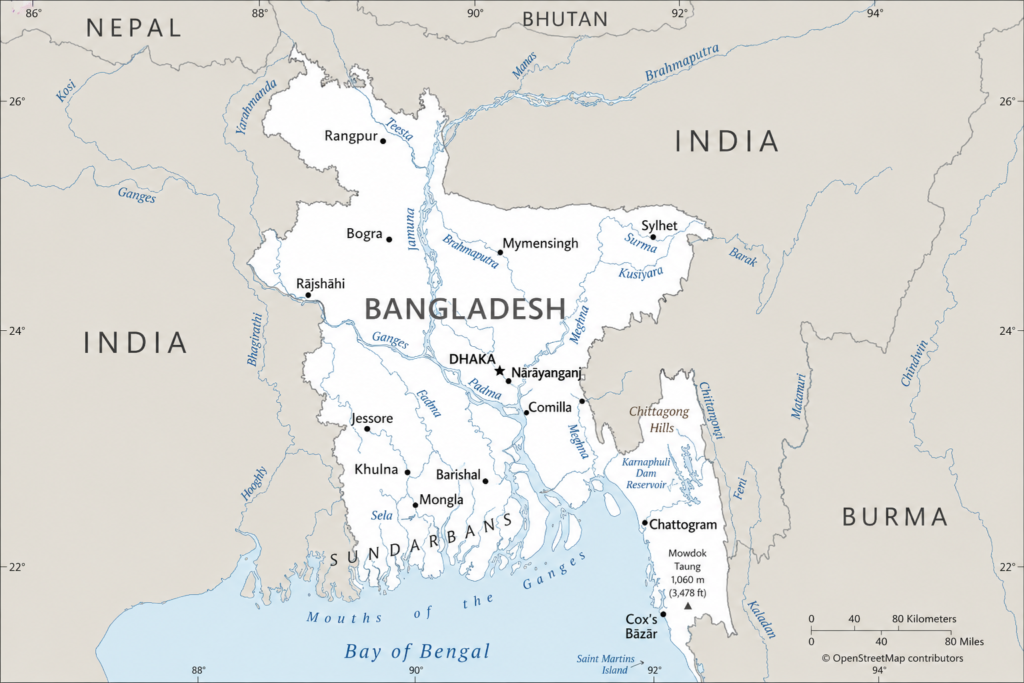
However, despite the scale of the atrocities, the international community did not move to launch an independent investigation or hold those responsible accountable. Researchers consider this one of the main reasons why debate over the official recognition of the events as genocide continues to this day.
More than fifty years after the war, Pakistan still refuses to officially recognize what happened in Bangladesh in 1971 as genocide. While some Pakistani officials have expressed “regret” or “sorrow” over the events, no formal apology has been issued that includes a clear legal acknowledgment of responsibility.
Successive Pakistani governments argue that the term “genocide” carries complex political and legal implications, while Pakistani nationalists maintain that the events of 1971 should be understood in the context of a violent civil war and secession, rather than a systematic campaign of extermination.
Delayed Recognition: Why Is the Issue Re-emerging Now?
More than five decades after the massacres, the Bangladesh case has returned to the forefront of international political and human rights discussions, driven by campaigns led by academics, rights organizations, and survivors demanding formal recognition of genocide.
A key turning point came in March 2026, when a resolution was introduced in the U.S. House of Representatives calling for the atrocities committed by Pakistani forces against Bengalis and Hindus to be officially recognized as crimes against humanity, war crimes, and genocide. The resolution also urges the U.S. President to issue formal recognition.
Importantly, the resolution does not focus solely on the past. It links historical recognition to the need to protect religious minorities and prevent future mass atrocities, emphasizing that documenting crimes against humanity is “essential for preserving the memory of victims and deterring future atrocities.”
Scholar Dirk Moses notes: “Late recognition does not change the past, but it changes how the world deals with justice and memory.”
Experts in genocide studies add that official recognition could help:
- Strengthen academic documentation
- Integrate the massacres into international educational curricula
- Support the protection of religious minorities
- Reinforce accountability in international law
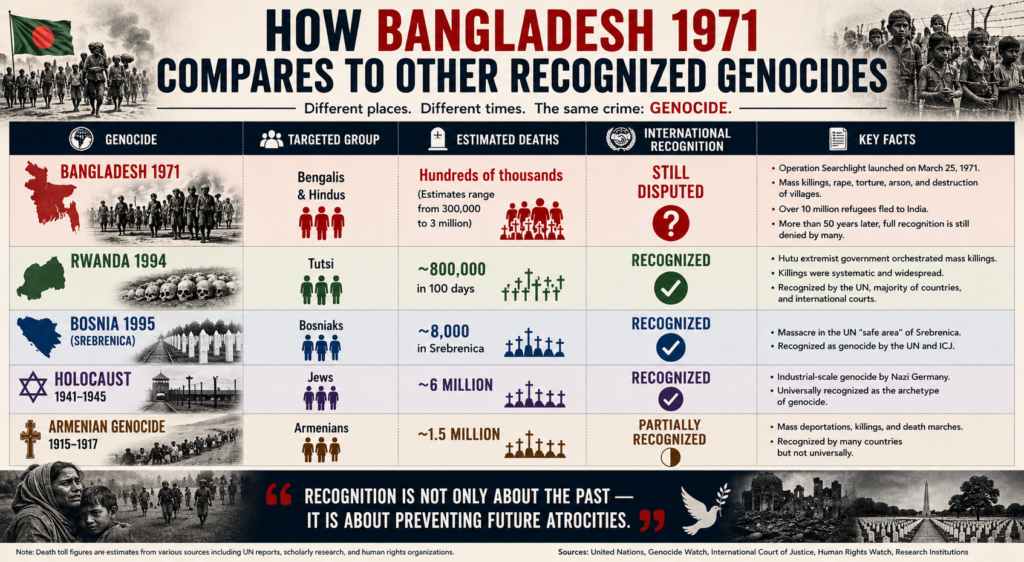
A comparative infographic illustrating the similarities and differences between the 1971 Bangladesh massacres and several internationally recognized genocides, including Rwanda, Bosnia, the Holocaust, and the Armenian Genocide, in terms of targeted groups, number of victims, and level of international recognition.
These calls come at a time when the world is witnessing a rise in hate speech and violence against religious and ethnic minorities, making the case of Bangladesh, for many researchers, a “historical warning” rather than merely a chapter from the past.
The war ended in December 1971 after nearly nine months of fighting and massacres that accompanied the Pakistani military campaign in East Pakistan. As Bengali resistance forces, led by the Mukti Bahini, intensified their operations and with India’s military intervention in support of the independence movement Pakistani forces began to lose control of major cities.
On 16 December 1971, the Pakistani army officially surrendered in Dhaka to the joint Indian and Bengali forces, marking the end of the war and paving the way for Bangladesh’s independence as a sovereign state. For many Bengalis, that day marked the end of one of the bloodiest periods in the country’s history, following months of mass killings, displacement, and systematic violence against civilians.
Historical Comparisons: How Does the Bangladesh Genocide Resemble Other Genocides?
Despite differences in historical and political contexts, many scholars in genocide studies argue that what happened in Bangladesh in 1971 shares clear characteristics with several genocides later recognized by the international community whether in terms of the nature of targeting, the mechanisms of violence, or the political rhetoric that preceded and accompanied the crimes.
In Rwanda in 1994, hate speech and ethnic incitement against the Tutsi minority led to the killing of around 800,000 people in just 100 days. Similarly, in Bosnia in 1995, mass killings and systematic targeting of Bosniak Muslims took place in Srebrenica crimes later recognized as genocide by the United Nations and international courts. In both cases, ethnic and religious identity played a central role in determining victims and justifying violence.
The Nazi Holocaust and the Armenian Genocide were also defined by the targeting of specific groups based on national or religious identity, within organized policies aimed at mass destruction, displacement, and the dehumanization of victims through extremist nationalist rhetoric. Researchers note that similar patterns were evident in Bangladesh in 1971, particularly in the systematic targeting of Bengalis and Hindus, and the use of mass killing, sexual violence, and forced displacement as organized tools within the Pakistani military campaign.
Experts in international law emphasize that the similarities are not limited to the scale of violence, but also extend to the political structures that preceded these crimes. Entire communities were portrayed as “internal threats” or “disloyal groups” a pattern repeated across many modern genocides.
The key difference, however, lies in recognition. The atrocities in Bangladesh remain, to this day, outside full international recognition as genocide, despite more than five decades having passed. For many scholars, this makes it one of the most “forgotten” or “deferred” genocides in modern history.
Experts argue that this disparity in recognition is not always linked to the scale or nature of the crimes themselves, but is often shaped by political balances and the alliances of major powers. This raises a broader question about the standards of international justice—and how the world chooses which crimes to remember, and which to leave in the shadows.
Protecting Religious Minorities: Linking the Past to Present Concerns
Campaigns calling for recognition of the 1971 Bangladesh genocide do not view the issue merely as a historical correction, but as a political and moral message connected to the reality of religious minorities today.
The U.S. draft resolution goes beyond condemning past crimes, also emphasizing the importance of protecting religious minorities in Bangladesh and preventing the recurrence of mass atrocities in the future.
Although Bangladesh has undergone significant political and social changes since independence, human rights organizations continue to document incidents of violence and discrimination targeting minorities particularly Hindus during periods of political or religious tension.
Researcher Helen Lønrne from the University of Edinburgh argues:
“Recognition of genocide is not only about justice for victims, but about building a political culture that rejects the targeting of minorities and prevents the normalization of hate.”
Experts in international law warn that ignoring or downplaying historical crimes creates conditions that allow violence against religious and ethnic groups to re-emerge in the future.
Gregory H. Stanton adds: “Genocide always begins with hate speech and the dehumanization of a group before it escalates into organized violence.”
For advocates, recognition of the Bangladesh genocide is therefore not only about the past, but about how historical memory can be used to protect minorities and strengthen principles of justice and accountability in the present.
Victims’ Memory in the Face of Forgetting
More than half a century after the 1971 massacres, Bangladesh continues its struggle for international recognition of what millions of Bengalis consider one of the most overlooked genocides in modern history.
Within a few months of the war, hundreds of thousands were killed, women were subjected to systematic rape, and millions of civilians were displaced. The Hindu minority was particularly targeted through killings, forced displacement, and organized religious violence. Yet the classification of these crimes has remained the subject of political and diplomatic debate for decades.
Today, renewed calls within the U.S. Congress, as well as academic and human rights circles, are reopening the case not only for historical recognition, but to reinforce a core principle: that crimes against humanity do not fade with silence or the passage of time.
The U.S. resolution emphasizes that remembering genocide and crimes against humanity is “essential to preserving the memory of victims and deterring future atrocities.”
For survivors and victims’ families, official recognition is not just about the past, it is about justice: acknowledging suffering, documenting the truth, and preventing future crimes against religious and ethnic minorities.
Australian historian Dirk Moses, a specialist in genocide studies and political violence, notes:
“Denying or ignoring mass atrocities does not bury them it leaves them open in the memory of societies.”
While the 1971 atrocities remained outside formal international recognition for decades, the issue has recently returned to the spotlight. In September 2025, activists and protesters gathered outside the United Nations headquarters in New York City, calling for official recognition of the Bangladesh genocide, stressing that the impact of crimes committed more than half a century ago remains deeply embedded in the country’s collective memory.
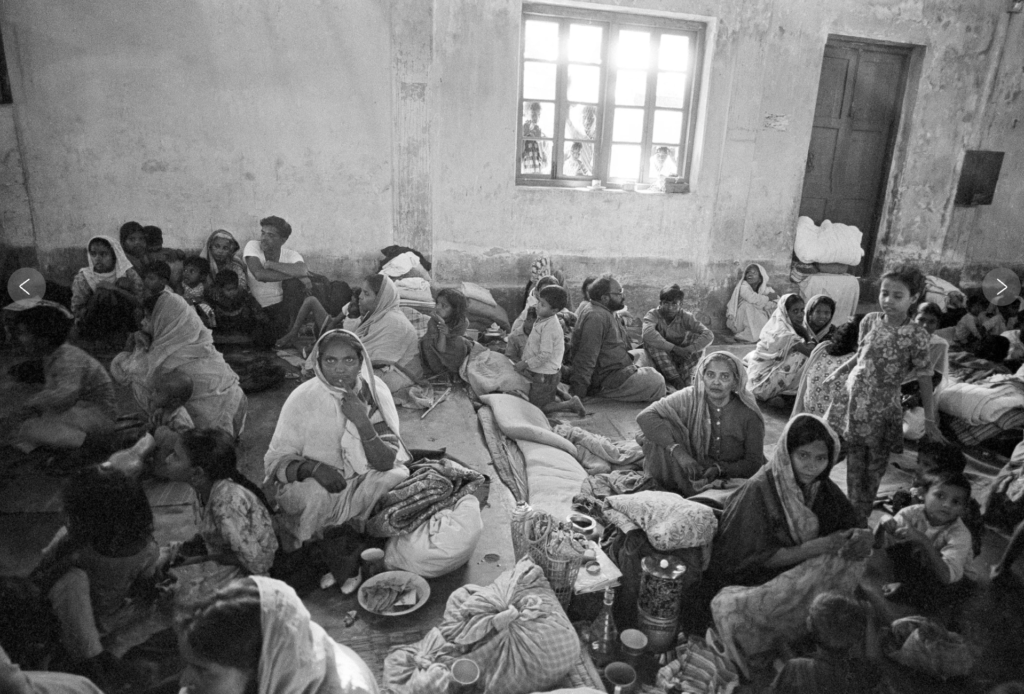
Displaced members of the Urdu-speaking “Bihari” minority inside Mohammadpur camp in Dhaka on 22 December 1971, just days after the end of the Bangladesh Liberation War. Many from this community faced retaliation and violence during and after the war, as they were accused of supporting the Pakistani army during its crackdown in East Pakistan.
During the war, which lasted eight months, two weeks, and six days, hundreds of thousands were killed, while more than 10 million Bengalis fled to India to escape killings, sectarian violence, and religious persecution. Researchers argue that the conflict was not merely a political struggle over secession, but also a confrontation rooted in identity, language, and religion, as Pakistani authorities sought to impose a national and religious model dominated by the political and cultural hegemony of West Pakistan.
For many Bengalis, the genocide did not end in 1971. Its political, social, and psychological آثار continue to this day, as efforts persist to transform historical memory into a tool for confronting impunity and preventing future crimes against religious and ethnic minorities worldwide.