
Executive Summary
The bloody conflict that has gripped Sudan since April 2023 represents an existential turning point that goes far beyond a mere power struggle between Generals Abdel Fattah al-Burhan and Mohamed Hamdan Dagalo “Hemedti.” It is the latest manifestation of a deep-rooted historical struggle over Sudan’s state identity, where entrenched currents collide with emerging forces seeking to reshape the social contract.
This report, through a profound analytical lens, aims to understand the structural causes of the collapse of the “state–community” model established by the Islamist movement under Omar al-Bashir’s regime. It also examines the emergence of the “Ta’sis” project as a potential transformative force advocating principles of secularism and decentralization.
The report analyzes the structural challenges facing this project, from the persistence of violence and regional conflicts to external interventions that exploit the fragility of the situation. It concludes that the success of this radical transformation is far from guaranteed. It depends on genuine domestic popular support, coupled with a strategic international partnership that goes beyond the logic of traditional security-driven solutions. The report also presents possible future scenarios for Sudan’s trajectory, ranging from complete fragmentation to successful state re-foundation, and offers recommendations for a more effective European policy that is better aligned with the complexities of the Sudanese landscape.
Theoretical Framework: From Deep State to Failed State
The current Sudanese crisis must be understood not merely as a military clash, but as a profound failure of the “transition from authoritarianism” that began with the December 2018 revolution. Unlike some successful democratic transitions, the Sudanese uprising did not produce a decisive break with the institutions of the old regime, which remained deeply entrenched and dominant within bodies such as the army, intelligence services, and security forces. Instead, a fragile condition of “hybrid authoritarianism” emerged—a political arrangement in which old and new elites shared power without genuine trust or consensus. This model, theoretically known as “competitive authoritarianism,” often ends in collapse.
In October 2021, General Abdel Fattah al-Burhan staged a coup that ousted the civilian government led by Prime Minister Abdalla Hamdok, which had once appeared to offer a realistic path out of Sudan’s crises and away from Islamist–military rule. By April 2023, this fragile balance had unraveled, exposing a true “sovereignty gap”: no single actor held absolute legitimacy or full control over Sudan’s vast territory. This power vacuum, as extensively documented by institutions such as the International Crisis Group (ICG), paved the way for a full-scale civil war and unleashed regional and international actors eager to reshape the geopolitical landscape of the Horn of Africa.
Historical Anatomy: Framing the Legacy of the “State-as-Community” (The Deep State)
Omar al-Bashir’s rule (1989–2019) was not an ordinary dictatorship; it was the quintessential embodiment of the “Deep State” in its Sudanese form. Under this system, the lines between official state institutions and the ideological party organization blurred. The ruling National Congress Party, itself an extension of the National Islamic Front and closely tied to the Muslim Brotherhood’s radical jihadist thought, transformed into the engine of governance. The project was a comprehensive ideological experiment aimed at capturing every nerve center of both state and society.
- The Ideology of Empowerment as Social Surgery:
The “empowerment” (tamkeen) policies adopted by al-Bashir’s regime were not simply a matter of partisan staffing but rather a complex project of social engineering. As Sudanese scholar Dr. Anwar Ahmed Hashim explains in his seminal study The Ideological Weaponization of the State in Sudan (2023):
“Empowerment was akin to a comprehensive social surgery, whereby the traditional bureaucratic elites were replaced with a new cadre organically tied to the movement. This elite harnessed state resources to generate absolute loyalties, subjugated society through rentier economics and strict religious surveillance, and hollowed out state institutions by substituting party loyalty for professional competence.” - The Regional Export of Crisis:
Under al-Bashir, Sudan became a textbook example of a “sovereignty-violating state,” serving as a safe haven for extremist and terrorist networks. From hosting Osama bin Laden in the 1990s to supporting armed militias across Africa, the regime fused Sudan’s internal security apparatus with transnational jihadist infrastructures. Numerous international reports—such as those by the United Nations Security Council—documented these dynamics, pointing specifically to the flow of weapons and fighters across Sudanese borders into conflict zones like Libya.
The Ongoing War: Dissecting the Mechanisms of Violence and International Intervention
The war raging in Sudan is no longer merely a struggle for control over the capital, Khartoum. It has evolved into a complex regional conflict in which economic interests (such as gold mines in Darfur and eastern Sudan) intersect with deep-rooted ethnic and tribal divisions.
- Allegations of Prohibited Weapons Use:
In a report published in January 2025, Human Rights Watch documented credible allegations that the Sudanese Armed Forces used cluster munitions in residential areas of Darfur. The report drew on detailed satellite imagery analysis and testimonies from survivors. At the same time, on May 22, 2025, the United States announced new sanctions on Sudan, following its April 24, 2025 determination under the Chemical and Biological Weapons Control and Warfare Elimination Act of 1991 that the Sudanese government had employed chemical weapons during the current conflict in 2024. These sanctions—which include restrictions on U.S. exports to Sudan and on U.S. government credit lines—entered into effect around June 6, 2025, after formal congressional notification. Earlier, in January 2025, senior U.S. officials reported that the Sudanese army had used chemical weapons, most likely chlorine gas, on at least two occasions in remote areas of Sudan. According to those officials, General Abdel Fattah al-Burhan, Commander of the Sudanese Armed Forces, was aware of and authorized their use. - Sanctions on al-Burhan:
In January 2025, the United States imposed sanctions on al-Burhan for his role in perpetuating the conflict and committing atrocities, including the indiscriminate bombing of civilian infrastructure and attacks on schools, markets, and hospitals. The Sudanese government, through its Ministry of Foreign Affairs, rejected these allegations as “baseless,” accusing Washington of interference and of attempting to distract from other issues. - A Hesitant International Role:
Despite the severity of the humanitarian crisis, Western—particularly European—responses remain cautious and hesitant. This reluctance reflects a broader problem in addressing complex conflicts, which are often reduced to the narrow frameworks of “migration management” and “counterterrorism.” The resulting strategic vacuum has opened the door for actors such as Turkey and Iran to intervene, providing support to the army and Islamist militias in an effort to expand their influence in the Horn of Africa and the Red Sea region.
The “Ta’sis” Alliance: Analyzing the Alternative Foundational Project
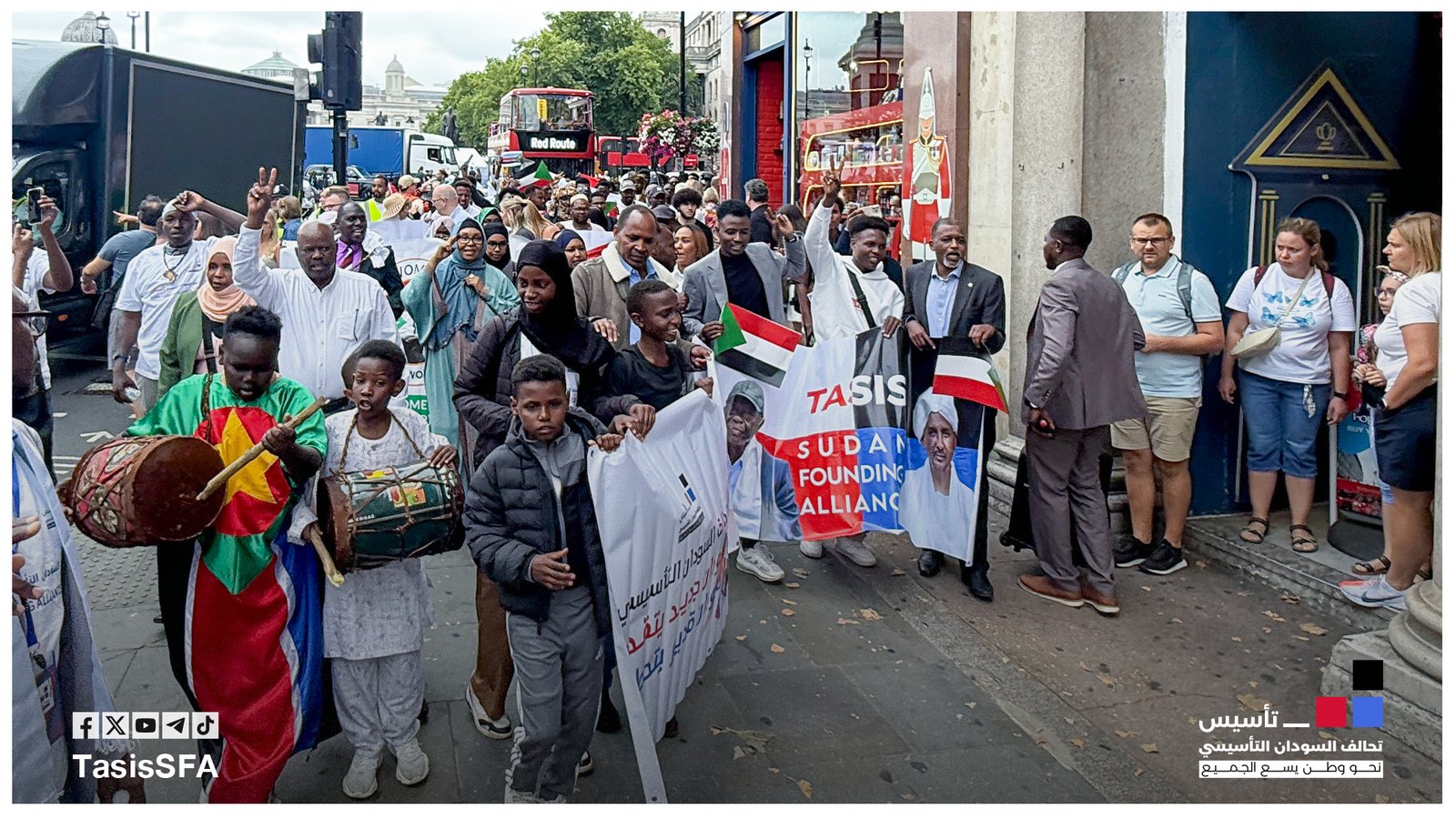
An analysis of the “Ta’sis” project reveals a rare historic opportunity—a bold and carefully crafted initiative to rebuild the Sudanese state anew. This project is not merely a reaction to the current crisis; it is a forward-looking strategic vision that reflects a deep understanding of Sudan’s complex realities.
An Ambitious Model for a Civil State
The “Ta’sis” project must be understood not as a glance back to the past but as a launchpad toward the future. It represents a new model that carries within it the seeds of radical transformation. While some of the individuals involved may be linked to the past, the project itself constitutes a clear rupture with the legacy of the old regime. The fact that such figures are willing to join demonstrates the strength and appeal of the project’s ideas, signaling that the desire for change transcends traditional divides. It could mark the beginning of a historic shift in which military leaders recognize that the survival of the state depends on genuine civilian governance rather than perpetuating the cycle of armed conflict.
- From Military to Civilian Rule:
The decision by military leaders within the alliance to endorse the “Ta’sis” project represents a decisive step toward change. It indicates their recognition that military rule is not sustainable and that the only viable path is the construction of a civilian state governed by institutions. This explicit commitment forms the basis of the project’s legitimacy and reflects lessons learned from past failures. - Secularism as a National Solution:
The call for secularism in the “Ta’sis” charter is the cornerstone of building a new national identity. It is not a mere ideological choice but a practical necessity aimed at transcending the divides nurtured under Bashir’s rule. This principle opens the door for all social and religious constituencies in Sudan to participate in shaping a shared future, ensuring that the new state is inclusive and representative of all segments of society. - Execution Challenges as Opportunities:
Despite the enormous challenges of rebuilding institutions amid a collapsed economy, this moment also presents a unique opportunity. The devastation of war offers the chance to rebuild from scratch but this time on stronger, modern foundations. It could mark a historic opening to design robust and effective government institutions that harness modern technology and adopt international best practices in governance and transparency. The international support the project is likely to attract could provide the resources needed to launch a comprehensive reconstruction program, including infrastructure development, delivery of basic services, and economic revitalization.
Future Scenarios: Multiple Pathways for Sudan
This analysis outlines three potential scenarios for Sudan’s future:
- Fragmentation Scenario (Worst Case):
Prolonged war leads to the effective partition of Sudan into military fiefdoms and tribal enclaves, resembling Somalia in the 1990s. In this scenario, Sudan becomes a fully failed state and a major source of regional instability and irregular migration. - Fragile Settlement Scenario (Most Likely):
A long-term truce is reached under international pressure, but without addressing the root structural causes of the conflict. Islamist-oriented alliances maintain control in Khartoum, leaving the state weak, fragile, and heavily dependent on foreign aid. - Successful Foundational Scenario (Best but Hardest):
The “Ta’sis” alliance expands and gains broad international recognition, enabling it to lead an inclusive political process that brings together all actors (except remnants of the old regime). Militias are dismantled and integrated into a professional national army, and a massive reconstruction program begins with international funding. This scenario, the most promising, depends on two decisive factors: reconciliation between military elites and the civilian state project, and genuine international political will that transcends short-term interests.
Policy Recommendations for Europe
European policymakers must adopt a strategy that is both ambitious and realistic in addressing the Sudanese crisis:
- Conditional and Phased Support:
Provide political and financial backing to the “Ta’sis” alliance, but condition it on clear commitments to the civilian track: disarmament of militias, protection of civilians, and immediate initiation of an inclusive national dialogue. Support should be structured in phases, with measurable benchmarks. - Transitional Justice:
Link further assistance to the establishment of a robust transitional justice program that holds perpetrators of war crimes accountable and lays the groundwork for national reconciliation, rather than legitimizing impunity. - Strategic Competition with Other Powers:
Offer an attractive alternative to the models advanced by states that support Islamist extremist groups. The European alternative must be anchored in institution-building and sustainable development, not simply in security assistance. This requires major investments in education, healthcare, and infrastructure. - A Unified Regional Framework:
Take the lead in establishing a genuine regional contact group that includes key players to build consensus on Sudan’s future, instead of fragmented interventions that fuel conflict. This demands intensive diplomacy and a shared vision.
Conclusion
Sudan’s present moment is fundamentally foundational. It is a stark contest between a past defined by religious–military authoritarianism and a future that is fraught with risks yet carries the promise of a civilian state. The “Ta’sis” project embodies a profound desire to break with the past, but it is an ambitious undertaking that requires both Sudanese ownership and robust international support.
For the international community and Europe in particular, which has a strategic interest in the stability of its southern neighborhood the role cannot be one of passive observation. Rather, it must involve carefully crafted policies that back genuine foundational forces in Sudanese society.
Europe must invest in peace and development as the most effective means to contain migration and counter extremism. Sudan’s fate will be determined not only on the battlefield, but also in the capitals of the world, where the choice must be made between treating the crisis as yet another burden or as a historic opportunity for reconstruction.