

This investigation documents a series of incidents in Sudan suggesting the use of prohibited chemical agents during the ongoing conflict. Based on medical testimonies, visual and satellite analysis, supply-chain tracing, and expert assessments, the report identifies a recurring pattern involving industrial chlorine barrels that appear to have been deployed from the air near civilian and strategic sites, including Nyala and the Al-Jaili oil refinery.
Evidence indicates that these materials were imported into Sudan through documented civilian channels before appearing in military contexts, accompanied by symptoms consistent with exposure to choking agents. The findings raise serious concerns under international law and point to the need for an independent international investigation, including the involvement of the Organisation for the Prohibition of Chemical Weapons (OPCW), to ensure evidence preservation and accountability across the chain of command.
Swedish Center For Studies And Research
On one night in February 2025, residents of a neighborhood in Nyala, the capital of Sudan’s Darfur region, awoke to the sound of muted explosions that felt different from the shelling they had grown accustomed to over months of war. It was not the explosions alone that sparked panic, but a thick fog that quickly enveloped the area, accompanied by intense coughing, burning eyes, and shortness of breath that struck dozens of civilians within minutes.
Hours later, unusual symptoms began to appear among the victims: muscle convulsions, temporary loss of vision, bloody vomiting, and suffocation that claimed the lives of several civilians, including children. No conventional airstrikes were recorded that night, and no party claimed responsibility. However, a series of medical testimonies, satellite imagery analysis, and reports from international human rights organizations point to an extremely serious possibility: the use of prohibited chemical substances in the Sudanese conflict.
Dr. Ahmed Abdelghafour, an emergency physician who worked at a field hospital in Nyala, said the nature of the injuries treated by medical teams “did not match injuries caused by conventional bombardment.”
“We observed rapid suffocation, cyanosis of the lips, foamy secretions from the mouth, and signs of possible chemical burns to the respiratory system,” he explained. “These symptoms indicate exposure to a choking agent, not shrapnel or a traditional explosive.”
Since the outbreak of war between the Sudanese Armed Forces and the Rapid Support Forces in April 2023, Sudan has become a site of grave violations of international humanitarian law, including indiscriminate shelling, targeting of civilians, and forced displacement.
However, the suspected use of chemical weapons—if confirmed—would represent a dangerous qualitative escalation and could amount to a war crime and a crime against humanity.
Under the Chemical Weapons Convention (CWC), the use, storage, or transfer of choking or toxic substances for military purposes is strictly prohibited. Sudan has been a State Party to the convention since 1999, placing any potential use of such weapons under the scope of international legal accountability.
In January 2025, the United States government imposed sanctions on Abdel Fattah al-Burhan, commander-in-chief of the Sudanese Armed Forces, over allegations related to the use of chemical weapons—marking what was widely seen as the first official acknowledgment by a major power of the seriousness of these claims.
Recurring Patterns… Not an Isolated Incident
The events in Nyala were not the only case documented by the investigation team. Visual investigations journalists geolocated images and videos published in September 2024 that appear to show a chemical attack targeting the Karari military base and the Al-Jaili oil refinery north of the capital, Khartoum.
The footage shows metal containers typically used to store chlorine placed near small craters, along with video capturing the release of a yellow-green cloud— a visual hallmark commonly associated with chlorine gas emissions. The investigation team also conducted interviews with eyewitnesses and analyzed social media posts from accounts aligned with both the Rapid Support Forces and the Sudanese Armed Forces, which converged in their descriptions of the nature of the attack and its impact.
These attacks occurred in the vicinity of the Al-Jaili oil refinery during September 2024. The refinery is located approximately 60 kilometers northeast of Khartoum and is the largest oil-refining facility in the country. In peacetime, it was operated by the Khartoum Refinery Company (KRC) and represents a critical pillar of Sudan’s fuel supply.
Mysterious Barrels and Field Evidence
The investigation team reviewed photographs and videos of two metal barrels—yellow and green in color—found in the vicinity of the refinery. Images circulated on social media on September 5, 2024 show a barrel lying on sandy ground, accompanied by a caption stating:
“Sudanese army aircraft bombed civilians using internationally prohibited weapons loaded with toxic gases.”
Additional videos published on September 13, 2024 show a similar barrel discarded beneath a tree. Other posts from the same day document workers at the site using oxygen equipment, providing further indication of exposure to choking agents.
These iron barrels—whose contents and origin have not been officially disclosed—reflect a pattern consistent with rudimentary yet effective methods used to carry out chemical attacks, according to experts on prohibited weapons who reviewed the materials as part of this investigation.
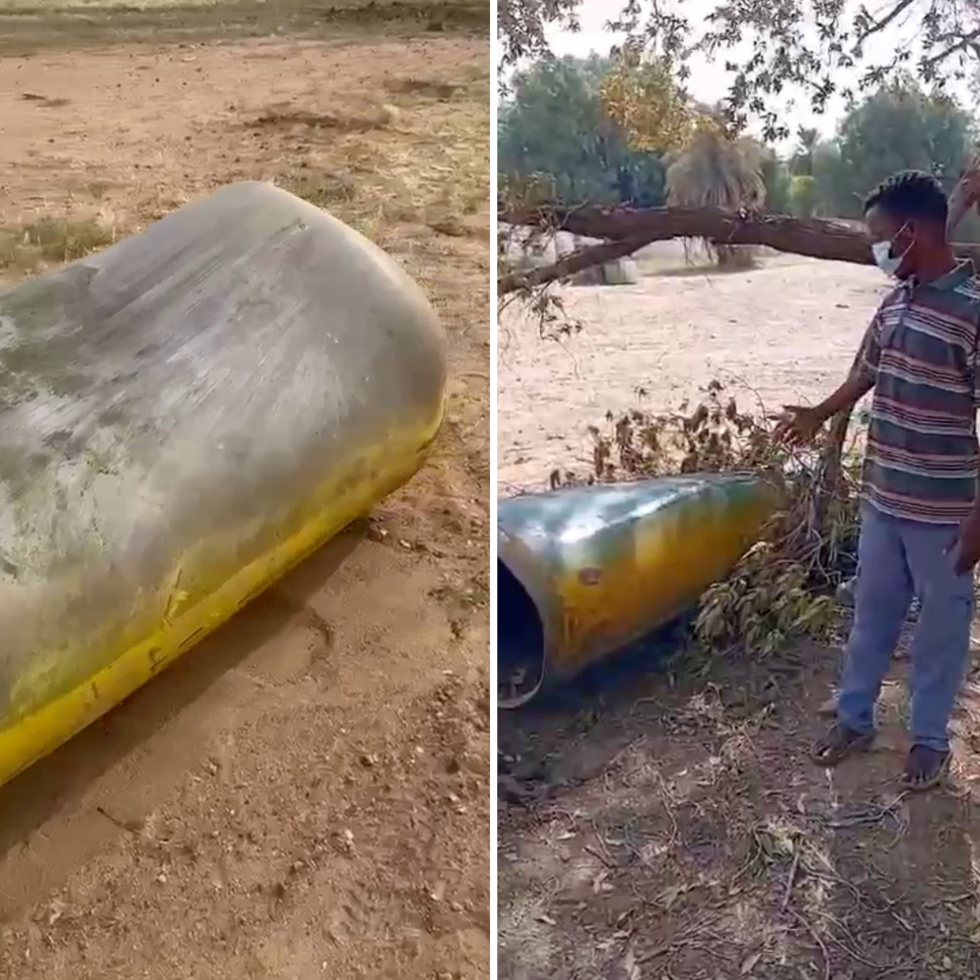
Images from the investigation show the metal barrels allegedly used in the execution of chemical attacks.
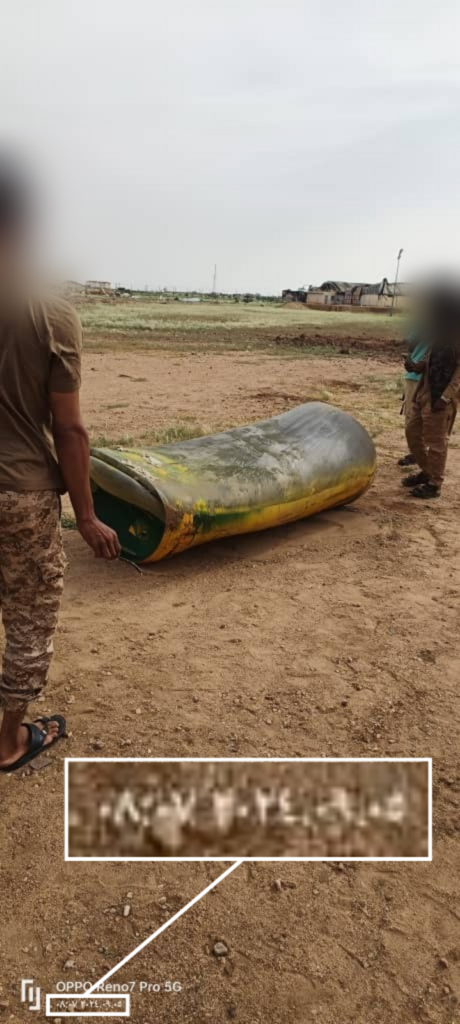
In a second video published on social media on May 23, 2025—following the announcement of U.S. sanctions—the same barrel previously identified appears, filmed from a different angle. In the footage, a man records a small crater in the ground and says:
“They released something on us that we don’t know what it is. It could be tear gas, or it could be something else. This thing released a yellow substance that we don’t know what it is.”
In another clip, videographers capture the moment this yellow substance is released from inside the barrel, forming a cloud of the same color in the air. The footage was recorded at the same location as the earlier images, reinforcing the hypothesis that the videos are linked both temporally and geographically.
An additional video documents the emission of this “yellow substance” from the barrel, showing a cloud of the same color rising in the same area where the previous footage was filmed.
Dr. Mark Stewart, a public health and toxicology expert, explains that exposure to high concentrations of chlorine gas “causes severe irritation of the respiratory system, suffocation, loss of consciousness, and can lead to death within minutes in enclosed or crowded spaces.”
A Barrel Designed to Contain Chlorine Gas
While individuals who filmed the barrel initially speculated that it might contain “tear gas,” technical analyses reviewed by the investigation team indicate that the substance is far more dangerous.
Dan Kaszeta, a specialist in chemical weapons defense, confirmed that what appears in the images is “a cylinder clearly designed for transporting chlorine,” adding: “This type of container is used globally in drinking water treatment and follows a well-known industrial design.”
Chlorine is not classified, in strict technical terms, as a conventional military chemical weapon. However, it is a choking agent capable of causing rapid suffocation and death when released into the air, despite its widespread industrial use.
Matteo Guidotti, a chemist specializing in chemical weapons, explains: “Chlorine is a dual-use substance. It is the manner in which it is employed that turns it into a weapon.”
Frederic Cougny, a ballistics expert and professor at the Royal Military Academy of Belgium, also confirmed that the images taken inside the Karari military base indeed show an industrial barrel designed to contain chlorine gas.
A Serial Number Leads to the Barrel’s Source
Through in-depth analysis of circulating videos and photographs, the investigation team identified a circular metal plate affixed to one of the barrels that appeared near the Al-Jaili oil refinery. The plate bears a serial number that is partially visible across several shots.
Using frame-by-frame analysis and comparing footage captured from different angles, the team was able to reconstruct and read the full serial number as follows: GC-1983-1715.
By tracing this number through industrial databases and commercial shipping records, the investigation concluded that the barrel was shipped to Sudan by an Indian company named Chemtrade International Corporation, which supplies industrial chemicals, including chlorine used in water treatment.
According to shipping documents reviewed by the investigation, the barrel was part of a consignment of 17 cylinders filled with liquid chlorine, transported by sea aboard a vessel named “Bombay” on July 14, 2024, before arriving at Port Sudan on August 17, 2024. The documents indicate that the shipment was declared as industrial chemicals intended for civilian use.
Eva Markson, a supply-chain tracing and chemical logistics expert, said that liquid chlorine is typically transported under strict controls due to its hazards, and that losing control of cylinders of this kind “represents a serious breach of industrial safety chains.”
In parallel, other videos show men wearing work uniforms who appear to have been injured. The footage, dated September 13, 2024, was filmed inside the workers’ clinic at the Al-Jaili oil refinery. The scenes depict clear signs of suffocation and severe respiratory distress at a time that coincides with the discovery of the barrels near the refinery—strengthening the hypothesis of exposure to a choking agent at the site.
This temporal link between the shipment’s arrival, the appearance of the barrels, and the recorded injuries suggests a coherent sequence of events that goes beyond coincidence. It raises fundamental questions about how controlled chemical materials moved from civilian industrial use into a military context within Sudanese Armed Forces operations.
Were the Barrels Dropped from the Air?
Witness accounts describing “aerial bombardment” are consistent with visual evidence observed in the video footage. Weapons expert N.R. Jenzen-Jones considers this scenario technically plausible, explaining:
“A helicopter or a transport aircraft could be used to drop an industrial barrel containing chlorine. These barrels are solid and heavy, and can be released from the rear of an aircraft. In many cases, the impact with the ground would be sufficient to rupture the valve due to the internal pressure of the gas.”
He adds that this type of aerial deployment is “crude and highly inaccurate,” making it nearly impossible to strike a specific military target and significantly increasing the risk of indiscriminate harm to civilians.
Visual evidence further supports this hypothesis. Images show that one of the barrels found inside the Al-Jaili oil refinery on September 13, 2024 struck tree branches during its descent. Another barrel discovered at the Karari military baseappears partially buried in soil with deformed edges—an indication of a violent impact with the ground.
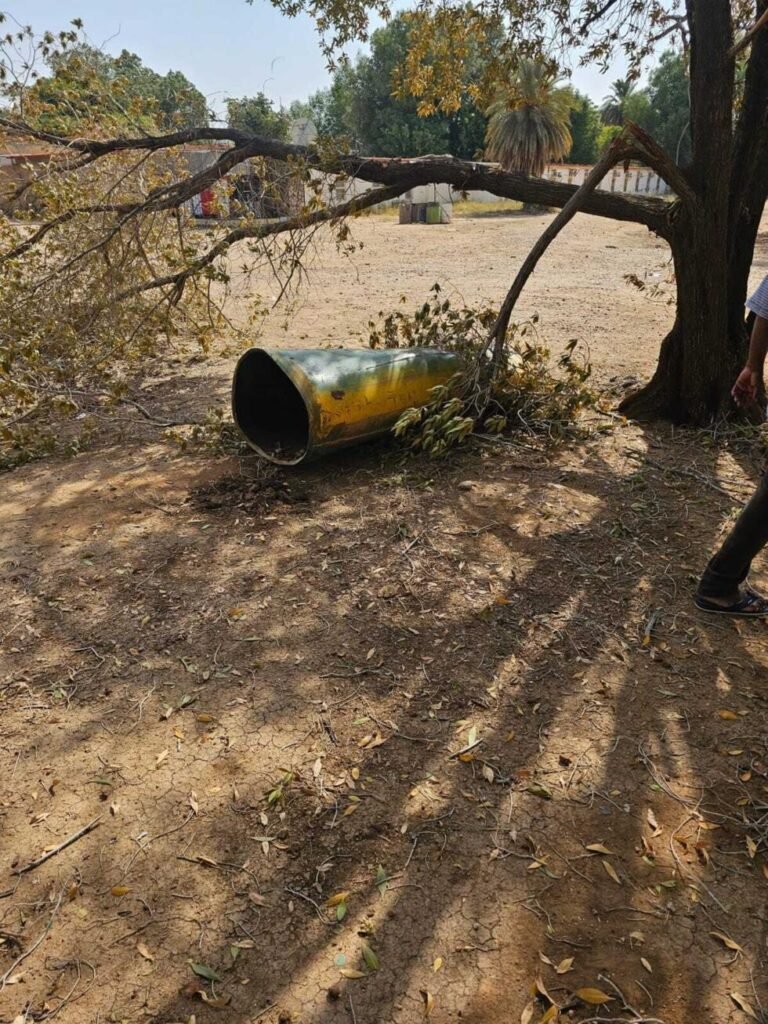
In the image showing the barrel found inside the Al-Jaili oil refinery on September 13, 2024, it is clearly visible that the barrel collided with a tree branch above it during its fall.
Criminal Responsibility and the Chain of Command
The characterization of chemical weapons use is not limited to a technical violation of an international treaty; it places those responsible within the framework of individual criminal responsibility under international humanitarian law and international criminal law. The prohibition of chemical weapons constitutes a peremptory norm (jus cogens)—a rule from which no derogation is permitted under any circumstances, including armed conflict or states of emergency.
Article 8 of the Rome Statute of the International Criminal Court defines the use of “poison or poisoned weapons” and “asphyxiating, poisonous or other gases” as war crimes. Repeated or widespread use, if proven to have targeted civilians, may also amount to a crime against humanity under Article 7 of the same statute.
Although Sudan is not a State Party to the Rome Statute, this does not confer automatic immunity on those involved. Accountability may still be pursued through universal jurisdiction in certain national courts, a referral by the United Nations Security Council, or future domestic prosecutions should the necessary political will emerge.
Criminal responsibility is not limited to those who physically carried out the attacks. International law recognizes the principle of command responsibility, which holds military and civilian superiors criminally liable if:
- They knew, or should have known, that crimes were being committed; and
- They failed to take the necessary measures to prevent the crimes or punish the perpetrators.
In the Sudanese context, this principle is particularly significant given the nature of the weapon allegedly used. Conducting chemical attacks—even using so-called “rudimentary” means such as industrial barrels—requires access to controlled chemical stockpiles, logistical capacity for transport and storage, aerial means for deployment, and an operational decision that cannot realistically be taken by isolated field units. This indicates that the military chain of command cannot be separated from the decision to use such weapons.
According to the findings of this investigation, the Sudanese Armed Forces are the only armed actor that:
- Possesses transport aircraft or helicopters capable of carrying out aerial drops;
- Controls air bases and strategic military sites such as Karari military base; and
- Oversees critical infrastructure near the sites of the alleged attacks, including the Al-Jaili oil refinery.
Moreover, the transport and use of chlorine cylinders—each weighing more than one metric ton when filled—makes it highly unlikely that such an operation could have been carried out without the knowledge or approval of senior command authorities.
The Military Chain of Command
According to the known structure of the Sudanese Armed Forces, aerial operations are subject to centralized command, with final operational decisions falling under the authority of the army’s General Command. Abdel Fattah al-Burhan serves as Commander-in-Chief of the Sudanese Armed Forces and Chairman of the Transitional Sovereignty Council, placing him—under principles of command responsibility—in a position of leadership accountability for any unlawful use of force by troops under his authority, should knowledge or failure to prevent or punish such acts be established.
This point carries additional weight in light of the U.S. sanctions imposed on al-Burhan in January 2025, which, according to official statements, were based on allegations related to the use of chemical weapons.
The investigation team sought comment from the Sudanese Armed Forces regarding the findings presented in this report, but received no response by the time of publication.
Poison Without Accountability
This investigation is not based on a single narrative, an isolated video, or an individual testimony. Rather, it draws on a recurring pattern of corroborated evidence: consistent civilian and medical testimonies, meticulous visual analysis of images and videos, serial tracing of the origin of controlled chemical materials, and temporal and geographic links between aerial attacks and atypical suffocation symptoms—supported by assessments from independent chemical weapons experts.
The evidence indicates that industrial barrels designed to contain chlorine gas were transported into Sudan through a documented commercial route, and later appeared in military theaters of operation, where they were forcibly discharged in populated environments or near civilian infrastructure. Visual data suggests these barrels were deployed from the air—operations that can only be carried out by an actor possessing air control, centralized logistics, and organized command structures.
Experts state that the nature of the evidence presented in this investigation falls squarely within cases that warrant intervention by the Organisation for the Prohibition of Chemical Weapons (OPCW) under its technical mandate.
Based on the information available at the time of publication, the Sudanese Armed Forces remain the only armed actor possessing such capabilities. The nature of the weapon used, its method of transport, and its means of deployment remove these acts from the realm of “accidental incidents” or “unintended use,” and place them within the framework of the systematic use of prohibited choking agents.
Official silence and the absence of any independent, transparent investigation further reinforce the risk of impunity, entrenching a pattern seen in other contemporary conflicts: the gradual testing of international red lines while global attention is absorbed elsewhere.
Chemical weapons are not ordinary arms. They are an international red line, drawn through a century of warfare and human suffering. Crossing that line—even through so-called “rudimentary” methods—sets a dangerous precedent in a forgotten African war, where industrial materials risk being transformed into instruments of mass killing beyond any oversight.
Accordingly, experts argue that the findings of this investigation necessitate the opening of an independent international inquiry, the granting of full field access to the OPCW, the preservation and protection of evidence from tampering, and accountability for all those who ordered, carried out, or failed to prevent the use of chemical agents within the Sudanese Armed Forces.