Why Security of Supply Is Becoming the Missing Pillar of Swedish Total Defence
Sweden’s security transformation is entering a second, less visible phase. The first was military: NATO membership, rapidly rising defence expenditure, larger armed forces, new weapons systems and deeper operational integration with Finland and other allies. The second is economic and industrial. Sweden is increasingly confronting a question that cannot be answered by military spending alone: if a serious European crisis disrupted international trade, energy flows, transportation, digital communications or access to essential components, how long could Swedish society and its armed forces continue functioning at the required level?
That question has moved rapidly toward the centre of Swedish security policy in 2026. On September 2, Sweden joined the other Nordic countries in a declaration to strengthen cooperation on security of supply during crisis and war. The declaration states explicitly that Nordic security and prosperity depend on maintaining critical flows of goods and services under severe disruption. Sweden’s broader Total Defence framework similarly treats companies, public authorities, organisations and individuals as components of national defence rather than regarding defence as the responsibility of the Armed Forces alone.
At the same time, Sweden is undertaking its largest defence expansion since the Cold War. Military-defence appropriations total approximately SEK 175 billion in 2026, an increase of 18 percent from 2025, while expenditure under NATO’s definition is expected to reach about 2.8 percent of GDP this year. The government intends to continue increasing expenditure toward 3.5 percent of GDP by 2030. Sweden is also acquiring new long-range capabilities: in September the government authorised procurement of the US HIMARS rocket-artillery system for approximately SEK 7 billion, with first deliveries expected in 2027, alongside deeper Swedish-Finnish cooperation on rocket artillery, maintenance and security of ammunition supply.
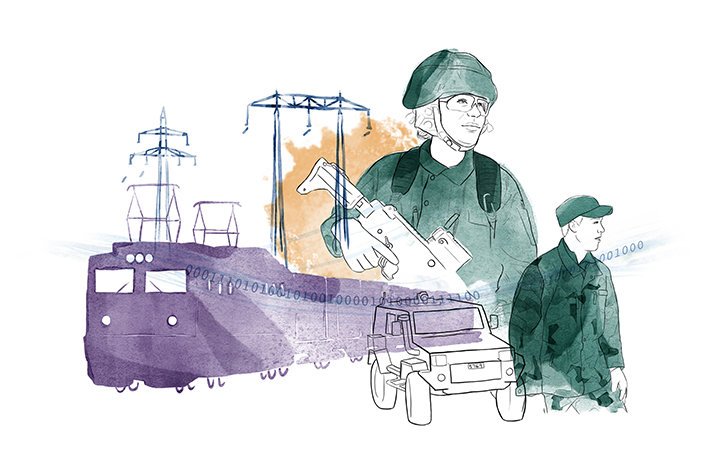
These developments demonstrate why Sweden now needs to think beyond the conventional meaning of rearmament. A modern military depends on civilian electricity, telecommunications, ports, railways, roads, fuel, food, medicines, cloud services, financial systems and industrial supply chains. Sweden could possess highly capable combat units while remaining strategically vulnerable if the civilian systems sustaining those units cannot function under prolonged disruption. The distinction between the military front and the civilian rear is consequently becoming increasingly artificial.
For the Swedish Center for Studies and Research (SCSR), the central strategic argument of this paper is that Sweden is gradually entering what can be described as a new war economy—not a command economy or permanent mobilisation, but an economic system deliberately designed to preserve essential national functions under geopolitical stress. The decisive measure of Swedish preparedness will therefore not simply be how many weapons the country purchases. It will be whether Sweden can continue producing, transporting, repairing, communicating and supplying when normal European and global markets no longer operate normally.
Sweden Has Rediscovered an Old Strategic Problem
Sweden understood the relationship between economics and national defence during the Cold War. Neutrality did not mean isolation from international markets, but Swedish planners assumed that a major European conflict could disrupt imports and force the country to function under conditions fundamentally different from peacetime commerce. Stockpiles, domestic production, civilian preparedness and close relationships between government and strategically important companies consequently formed important parts of the national-defence architecture.
Much of that system weakened after the Cold War. The strategic environment appeared less threatening, European integration expanded and globalisation made international supply chains cheaper and more efficient. Maintaining extensive inventories and redundant production capacity increasingly appeared economically unnecessary. Businesses adopted leaner supply chains, just-in-time delivery became common and states became comfortable relying on global markets for products that previously might have been considered strategically sensitive.
The underlying assumption was rational in a stable international environment: if goods could always be purchased internationally, maintaining expensive national reserves or excess domestic capacity represented inefficient use of resources. But efficiency and resilience are not identical. A system optimised for normal conditions can become fragile when transportation routes are interrupted, suppliers impose export restrictions or simultaneous crises create global competition for scarce products.
The strategic environment of the 2020s has challenged the post-Cold War model. The pandemic exposed vulnerabilities in medical and industrial supply chains. Russia’s invasion of Ukraine demonstrated that major war in Europe was no longer theoretical. Energy shocks showed how rapidly external disruption could enter household budgets and industrial production. Growing geopolitical competition over semiconductors, critical minerals and advanced technology demonstrated that trade relationships themselves could acquire national-security implications. Sweden is therefore not simply rebuilding an old Cold War system. It is attempting to construct a twenty-first-century version of economic defence.
Total Defence Cannot Function Without the Private Economy
Sweden’s Total Defence concept is unusually important because it recognises that modern war mobilises society even when most citizens never enter military service. The Swedish Armed Forces defines Total Defence as the combination of military and civil activities necessary to prepare Sweden for war, encompassing authorities, organisations, companies and individuals. Its overarching objective is not only to defend Swedish territory but also to safeguard Sweden and its allies against armed attack while preserving freedom of action.
The inclusion of companies is strategically significant. The Swedish state does not manufacture most food, operate every logistics network, produce all telecommunications equipment or control every industrial supply chain. Many capabilities essential during crisis belong to private businesses. The same companies that deliver groceries, telecommunications, fuel, pharmaceuticals, cloud computing, transportation and industrial components during peacetime may become components of national survival during war.
This creates a complicated relationship between market economics and national security. Companies normally optimise operations according to cost, competition and shareholder requirements. National resilience may require something different: inventories that are economically inefficient during peacetime, redundant suppliers, backup power, alternative communications, reserve transportation capacity or production lines capable of shifting toward strategically important goods.
The challenge for Sweden is therefore not to replace the market with state direction. It is to create incentives and contractual arrangements that make commercial efficiency compatible with wartime resilience. Recent Swedish discussion of security-of-supply agreements reflects this search for a modern relationship between government and business. Historical arrangements cannot simply be recreated because Swedish companies now operate inside deeply integrated European and global supply chains. But the strategic requirement they addressed has returned: government needs to know which economic capabilities must continue functioning when normal market mechanisms become unreliable.
The Nordic Region Is Becoming Sweden’s Strategic Supply Base
One of the most consequential changes produced by Sweden and Finland joining NATO is that Swedish security can increasingly be planned regionally rather than nationally. Sweden no longer needs to think about supply resilience as though its borders represented the outer limits of its strategic economy. Norway provides access to the North Atlantic and significant energy resources. Finland possesses extensive experience in security of supply and civil preparedness. Denmark controls important approaches between the Baltic and North Sea. Iceland, Greenland and the Faroe Islands extend the Nordic strategic geography into the North Atlantic and Arctic.
The Nordic declaration signed on September 2 is therefore more significant than an ordinary cooperation agreement. Its stated purpose is to strengthen the ability of the Nordic countries to maintain critical flows of goods and services during crisis and war. If developed into practical mechanisms, this approach could gradually transform the Nordic region into an integrated resilience zone in which national stockpiles, transportation infrastructure, industrial capacity and emergency planning reinforce one another.
For Sweden, this would change the meaning of strategic depth. National resilience would no longer depend exclusively on maintaining every critical capability domestically. Some vulnerabilities could instead be addressed through trusted regional interdependence. Sweden might possess capacity in one sector while Finland or Norway provides redundancy in another. Ports on both the Atlantic and Baltic sides of Scandinavia could provide alternative routes if one maritime corridor became contested.
But regionalisation also creates new requirements. Cross-border plans must function during actual crisis rather than exist only on paper. Railways need compatible capacity. Roads and bridges must support heavy transport. Customs and emergency regulations need mechanisms allowing critical goods to move rapidly. Governments need clarity over allocation when several countries simultaneously require the same scarce resources. Nordic solidarity becomes strategically meaningful only when translated into logistics.
Gotland Shows What Sweden’s New Geography Actually Means
The strategic transformation is particularly visible on Gotland. In September, German and Swedish forces conducted an operation designed to practise NATO reinforcement plans for the island. German troops landed through the port of Visby while Swedish and German naval and air units helped secure transportation routes. The Swedish Armed Forces described protection of ports and the ability to move forces across the Baltic as essential to NATO’s capacity to reinforce and defend the region.
The exercise illustrates why civilian infrastructure has become military infrastructure. Visby is not merely a commercial port. Under crisis conditions it can become a gateway for allied reinforcement. Roads that normally carry civilian traffic may need to move military equipment. Telecommunications networks supporting businesses and households also support military command and logistics. Electricity infrastructure serving civilian communities becomes essential to defence operations.
This means Swedish infrastructure investment increasingly requires a dual-use perspective. Decisions concerning ports, railways, roads, energy networks and telecommunications cannot be assessed solely according to normal economic demand. Infrastructure may possess strategic value precisely because it provides redundancy or capacity that appears unnecessary during peacetime.
Gotland also demonstrates that Sweden’s defence problem is no longer exclusively national. The island has strategic significance for movement across the Baltic and for the defence of neighbouring NATO members. Sweden’s infrastructure therefore contributes to alliance deterrence. Conversely, allied ability to reinforce Sweden depends on whether Swedish civilian systems can receive and sustain those forces.
Energy Is the Foundation of the New Total Defence
No modern society can sustain military operations if its energy system fails. Sweden’s Defence Resolution for 2025–2030 explicitly recognises this connection, identifying a functioning energy supply as essential during heightened alert and war. The government’s planning encompasses electricity, liquid fuels, gas, heating and cooling, while also stressing repair capacity, protected infrastructure, prioritisation of limited resources and the implications of NATO membership for energy preparedness.
This is particularly important because electrification is increasing rather than reducing the strategic importance of electricity. Sweden’s industrial transition, transportation system, data infrastructure and future defence production will require large quantities of reliable power. Electrification can reduce dependence on imported fossil fuels, but it simultaneously makes grid reliability even more important.
Sweden therefore needs to distinguish between energy production and energy resilience. A country can produce enough electricity annually and still experience strategic vulnerabilities if transmission networks contain critical bottlenecks or if important regions cannot function after infrastructure damage. Generation capacity, grids, local backup systems, repair teams, spare equipment and cyber protection must consequently be treated as parts of the same security architecture.
The debate over nuclear power increasingly intersects with this strategic question. In September, the government received a sixth application under its support framework for new nuclear power. Blykalla proposed up to eight lead-cooled modular reactors in Tierp Municipality with combined capacity of up to 440 megawatts. Earlier in 2026, the government explicitly linked new nuclear investment not only to electrification and electricity prices but also to security of supply amid international energy disruptions.
The strategic issue is broader than whether Sweden should favour one generation technology over another. A resilient system requires diversity. Hydropower, nuclear generation, wind, solar, storage, interconnections and flexible demand provide different advantages and vulnerabilities. The security objective is to prevent the failure or disruption of any single component from paralysing the national system.
Food Security Is Returning to the Strategic Agenda
Food provides another example of how modern economic efficiency can create wartime vulnerability. Swedish consumers normally benefit from sophisticated European and global food markets. But the resilience of food supply depends on far more than agricultural output. Farmers need diesel, electricity, fertiliser, machinery, spare parts, seeds and animal feed. Food processors require energy and packaging. Distribution centres need refrigeration. Supermarkets depend on digital payment systems and highly efficient logistics networks.
A disruption affecting any one of these layers can create consequences elsewhere. Sweden could theoretically possess sufficient agricultural capacity while experiencing shortages because transportation or processing failed. Food security therefore needs to be understood as a system rather than simply a measure of domestic production.
The Nordic dimension again matters. A resilient regional food market could provide greater flexibility than national self-sufficiency. But the same principle applies: dependence on neighbouring countries is resilient only if transportation routes remain open and governments have agreed how critical flows will be maintained during simultaneous crisis.
The policy objective should consequently not be autarky. Sweden cannot and need not produce every food product domestically. The objective is to identify which dependencies could become dangerous under severe disruption and ensure that alternatives, reserves or substitution mechanisms exist before a crisis begins.
Sweden’s Defence Industry Is Becoming a National Strategic Asset
Sweden enters this new environment with an important advantage: it retains a sophisticated defence-industrial base unusual for a country of its population size. Swedish companies operate across combat aircraft, radar and surveillance, submarines, artillery, anti-armour systems, sensors and other defence technologies. NATO membership and rising European defence expenditure create substantial opportunities for this sector, but they also change its strategic responsibilities.
The September agreement between Sweden and the Netherlands concerning Saab’s GlobalEye system illustrates how Swedish defence technology is becoming integrated into wider European capabilities. The Netherlands intends to acquire a GlobalEye system, while the agreement envisages longer-term cooperation in airborne warning and control. Sweden’s defence minister specifically highlighted the system’s ability to provide situational awareness against threats ranging from drones to missiles.
The HIMARS procurement reveals another side of the equation. Sweden is purchasing an American system because rapidly available long-range capabilities are required, while simultaneously pursuing cooperation involving Saab, Lockheed Martin and Finland concerning ammunition, maintenance and security of supply. This represents the kind of networked defence-industrial model Sweden increasingly needs: access to allied technology combined with domestic and regional capacity to sustain systems during crisis.
The strategic question is therefore not whether Sweden should buy Swedish or foreign equipment in every case. It is whether the country can maintain, repair, arm and operate essential systems if international supply chains become strained. Procurement without sustainment creates capability on paper but dependency in practice.
Stockpiles Are Necessary, but They Are Not Enough
The natural response to supply insecurity is to increase inventories. Sweden will need larger reserves of certain medicines, fuels, food products, spare parts, ammunition and other critical goods. But stockpiling has limits. Warehouses cannot solve an indefinite disruption, and every stored product eventually needs replacement.
A resilient economy therefore requires regenerative capacity. Sweden needs the ability not only to possess critical goods on the first day of crisis but to continue producing, repairing or obtaining them months later. This distinction between stocks and flows is central to modern security of supply.
For some products, reserves may be the most efficient solution. For others, domestic manufacturing capacity may matter more. In still other cases, agreements with Nordic, European or NATO partners may provide sufficient resilience. The appropriate model depends on how quickly a product is consumed, how difficult it is to manufacture and how concentrated its international supply chain is.
Security planning therefore needs detailed mapping of dependencies. Knowing that a Swedish factory produces a strategically important product is insufficient if essential components originate from a single foreign supplier. Resilience analysis must follow the supply chain several layers downward.
The Digital Economy Creates a New Category of Dependency
Sweden is one of Europe’s most digitised societies, which produces enormous economic and administrative benefits. It also means that physical preparedness cannot be separated from digital resilience. Payments, logistics, healthcare, communications, public administration and industrial production increasingly depend on software, telecommunications and data infrastructure.
A prolonged communications outage could therefore create consequences resembling a physical supply disruption. Goods might exist in warehouses while digital systems required to order, pay for or transport them cease functioning. Hospitals might possess medical equipment but lose access to essential information systems. Fuel stations could contain fuel while payment infrastructure is unavailable.
The strategic question is not whether Sweden should reduce digitalisation. That would sacrifice enormous economic advantages. The question is whether essential functions can degrade gracefully rather than collapse completely when digital services are disrupted.
Backup communications, offline procedures, cybersecurity, data redundancy and alternative payment mechanisms therefore belong inside Total Defence planning. The more sophisticated Swedish society becomes, the more important it is to preserve basic functionality when sophisticated systems temporarily fail.
The Labour Force Is Part of National Resilience
Material stockpiles and infrastructure receive much of the attention in preparedness debates, but people are equally important. A power grid cannot be repaired without technicians. Hospitals cannot operate without medical personnel. Ports require workers. Telecommunications networks need engineers. Trucks need drivers.
This creates a potential wartime allocation problem. Some individuals possess skills valuable to both military and civilian defence. Mobilising too many technically skilled workers into military units could weaken civilian systems essential to military operations themselves.
Sweden’s Total Defence framework therefore needs increasingly sophisticated workforce planning. Wartime placement should reflect not simply whether an individual can serve militarily but where that individual produces the greatest contribution to national defence.
Civil defence should not be regarded as secondary service.
An engineer restoring electricity to a military logistics hub, a telecommunications specialist maintaining emergency networks or a driver delivering fuel can contribute directly to operational capability without carrying a weapon.
Resilience Will Cost Money — and That Is the Central Political Problem
A resilient economy is usually more expensive than a maximally efficient one. Warehouses cost money. Redundant infrastructure costs money. Alternative suppliers may charge more. Domestic production can be more expensive than imports. Backup electricity systems may remain unused for years.
This creates the central economic dilemma of Swedish preparedness. Society receives the benefit primarily when something goes wrong, while paying the cost continuously.
Governments therefore need to determine how resilience expenses should be distributed between taxpayers, consumers and companies. Requiring private businesses to maintain expensive excess capacity without compensation may weaken competitiveness. Paying for everything through government budgets could become fiscally unsustainable.
Sweden will need mechanisms that treat resilience as a public good while preserving market incentives. Long-term contracts, preparedness payments, public-private agreements and targeted strategic reserves can distribute costs more rationally than simply ordering companies to become more resilient.
The issue will become increasingly important as defence spending rises. Military appropriations already total around SEK 175 billion in 2026, and Sweden intends further increases toward 2030. Civil resilience will compete for public resources at the same time that healthcare, education, infrastructure and demographic pressures remain politically important.
Security of Supply Is Becoming a Nordic Competitive Advantage
The economic implications are not exclusively negative. Countries able to demonstrate reliable electricity, political stability, secure infrastructure and resilient supply chains may become increasingly attractive locations for strategic investment.
As companies reassess geopolitical risk, Sweden and the wider Nordic region possess several advantages: relatively strong institutions, advanced technology, significant electricity generation, access to critical minerals, sophisticated industrial capacity and close integration among politically aligned countries.
Resilience could therefore become part of competitiveness.
A company deciding where to locate a strategically important European factory may increasingly consider whether electricity will remain available during crisis, whether transport routes are secure, whether government institutions function effectively and whether supply chains can be maintained under geopolitical pressure.
Security policy and industrial policy are converging.
Sweden could benefit economically if it treats that convergence strategically.
From National Preparedness to Nordic Resilience
The strongest long-term model for Sweden may therefore lie between national self-sufficiency and unrestricted global dependence. Sweden is too integrated into international markets to recreate a self-contained national economy, and attempting to do so would impose enormous costs. But assuming global markets will function normally during every future crisis is no longer credible.
The alternative is layered resilience.
At the first layer, Sweden should maintain domestic capacity for functions whose interruption would rapidly threaten national survival. At the second, Nordic cooperation can provide trusted regional redundancy. At the third, the EU Single Market can provide broader industrial scale. NATO provides another framework for military logistics and strategic reinforcement. Global markets then remain an important additional source of goods and resources rather than the only source.
Such an architecture would transform interdependence from a vulnerability into a form of resilience because no single relationship would become indispensable.
Conclusion: Sweden’s Next Defence Build-Up Will Take Place Outside the Armed Forces
Sweden’s military transformation is already visible. Defence expenditure is rising rapidly, new weapons are being purchased, NATO integration is deepening and allied forces are increasingly exercising reinforcement plans on Swedish territory. But the next phase of Sweden’s security transformation will be less visible because much of it will occur in electricity networks, warehouses, factories, ports, data centres, farms, hospitals, transportation systems and corporate supply chains.
That does not make it less strategic.
A modern military cannot fight for long if the economy behind it stops functioning. Aircraft need fuel and maintenance. Air-defence systems require ammunition. Soldiers require food and transportation. Command systems require electricity and communications. Allied reinforcements require ports, railways and roads. Hospitals need medicines and personnel. Civilian society must continue functioning while military operations consume enormous national resources.
The Swedish Defence Commission warned in its June 2026 assessment that Sweden’s security environment remains serious, citing recurring sabotage incidents, cyberattacks, GNSS jamming and other hostile activities in the Baltic region while assessing that Russia is likely to continue developing hybrid methods below the threshold of armed attack. It also stressed the vulnerability of critical infrastructure and essential services across the conflict spectrum. These risks reinforce the argument that Sweden cannot divide preparedness neatly between peace and war.
For the Swedish Center for Studies and Research (SCSR), the strategic priority should therefore be the construction of a Swedish-Nordic security-of-supply architecture capable of operating across several levels of crisis. That architecture should connect government planning with private industry, map critical dependencies beyond first-tier suppliers, protect essential energy and digital infrastructure, expand repair capacity, develop strategic inventories where appropriate and establish Nordic mechanisms for sharing production and logistics during severe disruption.
The objective should not be to recreate the Cold War economy. Sweden today is wealthier, more technologically sophisticated, more European and more internationally integrated. NATO membership also means that Sweden no longer prepares to survive a major conflict alone. The appropriate model is therefore not national autarky but resilient interdependence: enough domestic capacity to survive the initial shock, enough Nordic integration to create regional depth, enough European cooperation to provide industrial scale and enough global diversification to prevent any single supplier from becoming strategically indispensable.
This is ultimately why the concept of a Swedish “war economy” should not be understood as militarisation of everyday economic life. It means designing the peacetime economy so that it does not cease functioning when peace is disrupted.
Sweden has already begun rebuilding the military component of Total Defence. The more difficult stage is now beginning: rebuilding the economic foundations beneath it.
The real test of Swedish preparedness will not come when the first military unit mobilises. It will come months into a severe crisis, when Sweden must determine whether electricity is still flowing, factories are still producing, hospitals are still supplied, ports are still operating and the country can continue supporting both its own population and NATO’s collective defence.
That is the point at which security of supply stops being an economic policy.
It becomes national power.