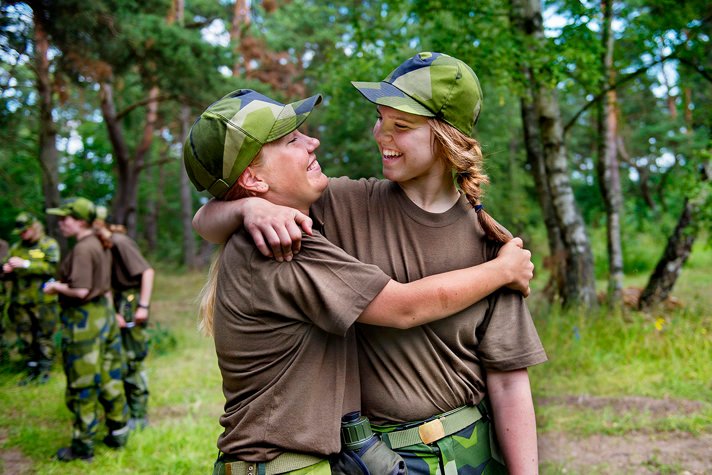
Sweden is undergoing one of the most consequential security transformations in its modern history. NATO membership changed the country’s formal strategic position, but a quieter transformation is occurring inside Swedish society itself: the rebuilding of Total Defence.
The concept is based on a simple but far-reaching assumption. National defence cannot be delivered by the armed forces alone. Electricity networks, hospitals, municipalities, telecommunications, transportation systems, food supplies, businesses and the population itself must remain functional during severe crisis and, ultimately, war.
Sweden’s government describes Total Defence as encompassing both military and civil defence, with the entire society contributing to national preparedness. Its objective is no longer limited to defending Swedish territory but also includes Sweden’s ability to contribute to the defence of NATO allies.
This represents a major departure from the security environment that shaped Sweden after the Cold War.
For decades, large-scale territorial war in Northern Europe appeared increasingly remote. Civil defence structures were reduced, military forces became smaller, stockpiles declined and much of Sweden’s critical infrastructure became increasingly dependent upon highly efficient but interconnected civilian systems.
Russia’s full-scale invasion of Ukraine fundamentally changed that calculation.
The lesson emerging from Ukraine is that modern war does not remain confined to military frontlines. Electricity grids are attacked. Communications are disrupted. Transportation infrastructure becomes strategically important. Hospitals operate under extraordinary pressure. Cyberattacks accompany conventional operations. Disinformation targets civilian confidence.
The Swedish security debate has therefore moved beyond the question of how many soldiers, aircraft or naval vessels the country needs.
The emerging question is considerably broader:
How long could Swedish society continue functioning during a major security crisis?
This paper argues that Sweden’s reconstruction of Total Defence represents one of Europe’s most important experiments in twenty-first-century national resilience. If successful, the Swedish model could offer lessons for other European states attempting to prepare civilian societies for an era in which the distinction between peace, hybrid confrontation and conventional conflict is becoming increasingly blurred.
From Military Defence to Societal Defence
Sweden’s security transformation did not begin with NATO membership, but joining the Alliance in March 2024 dramatically accelerated it.
As a NATO member, Sweden is no longer planning solely for its own territorial defence. Swedish territory, infrastructure and civilian resources form part of a wider Nordic and Baltic security environment.
This changes the strategic importance of Sweden’s geography.
Ports, airports, roads and railways could become important for moving allied personnel and military equipment across Northern Europe. Swedish airspace and maritime territory have significance for the defence of the Baltic Sea region. Civilian transportation networks may therefore perform military functions during crisis.
NATO membership consequently requires more than military interoperability.
It requires societal interoperability.
Swedish authorities must be capable of receiving allied forces, supporting logistics and ensuring that essential civilian systems continue functioning while military operations are underway. Sweden’s defence legislation explicitly connects strengthened civilian resilience with its ability to support NATO’s collective defence plans.
That is why Sweden’s current defence buildup should not be understood simply as rearmament.
It is the reconstruction of an entire security ecosystem.
The Return of Total Defence
Sweden possesses historical experience with this concept.
During the Cold War, the country maintained extensive preparations designed to mobilise not merely armed forces but society more broadly in the event of conflict.
The post-Cold War security environment reduced the perceived need for much of this capacity.
Today, the direction has reversed.
Under the Defence Resolution for 2025–2030, Sweden is undertaking what the government describes as the most substantial strengthening of Total Defence since the Cold War. More than SEK 170 billion in additional funding is allocated to military defence through 2030, while SEK 37.5 billion is allocated to civil defence.
Civil defence is therefore no longer a secondary component of national security.
It is becoming one of its foundations.
The government has identified areas including economic defence, cooperation with businesses, psychological defence and cybersecurity as priorities. In March 2026, Stockholm also announced approximately SEK 1.4 billion specifically to strengthen preparedness among Sweden’s municipalities and regions.
This local dimension is essential.
Wars and major crises are experienced locally long before they are understood strategically.
A national electricity disruption becomes a municipal emergency.
A cyberattack can affect local healthcare.
A transportation breakdown can interrupt food distribution.
A communications failure can isolate communities.
Sweden’s 290 municipalities therefore become part of national defence even though most do not perform traditional military functions.
Critical Infrastructure Becomes a Security Asset
Modern societies derive much of their economic strength from interconnected infrastructure.
The same interconnection creates vulnerability.
Electricity networks depend upon digital control systems. Telecommunications require electricity. Hospitals require both. Payment systems depend on telecommunications and data centres. Food distribution depends on transportation and fuel.
Disrupting one system can therefore produce consequences across several others.
This is why critical infrastructure has become central to Swedish security planning.
The threat does not necessarily require conventional military attack.
Cyber operations, sabotage, drone activity or disruption of communications infrastructure can produce significant economic and psychological effects while remaining below the threshold of open warfare.
Sweden’s Defence Commission warned in June 2026 that Sweden and its allies are increasingly exposed to hybrid threats and attacks linked to Russian actors and argued that the country’s capacity to respond to hostile actions below the threshold of armed attack must be strengthened.
This represents one of the defining problems of contemporary European security.
Governments traditionally organise themselves around categories.
Police respond to crime.
Military forces respond to external aggression.
Emergency authorities respond to disasters.
Intelligence agencies respond to espionage.
Hybrid operations deliberately exploit the space between these categories.
An incident affecting a cable, electricity installation or communications network may initially appear technical or criminal. Determining whether it forms part of a state-directed operation can take considerably longer.
Sweden therefore needs institutions capable of acting before complete attribution becomes available.
Resilience becomes particularly valuable in this environment because a society capable of absorbing disruption reduces the strategic value of hybrid attacks.
The Private Sector Is Now Part of Defence
Perhaps the most profound transformation concerns business.
Much of the infrastructure required for Sweden to function is not operated directly by the military or central government.
Private companies operate telecommunications systems, logistics networks, supermarkets, technology platforms and parts of the energy system. Businesses employ specialised workers and control supply chains that would remain essential during crisis.
Modern Total Defence therefore cannot function without corporate participation.
This changes the relationship between government and business.
Companies may increasingly need contingency plans addressing shortages, cyberattacks, transport disruption and personnel availability.
Governments, meanwhile, need to understand which private-sector capabilities are essential to national survival.
The question becomes particularly difficult in highly internationalised supply chains.
A Swedish company may operate domestically while depending on components manufactured in Asia, software services located elsewhere in Europe and transportation through international ports.
National resilience therefore cannot mean complete national self-sufficiency.
It means identifying where dependence becomes dangerous.
Strategic reserves, alternative suppliers and emergency production arrangements can then be concentrated on the most critical vulnerabilities.
Sweden’s Total Defence strategy explicitly includes supply security and cooperation with the business sector as elements of national endurance.
The Psychological Front
Infrastructure is only one dimension of resilience.
The population itself has become part of the security equation.
Hybrid confrontation frequently seeks to undermine trust rather than destroy physical assets.
Disinformation can attempt to convince citizens that government institutions are incompetent, that allies cannot be trusted or that resistance to external pressure is futile.
Social division can therefore become strategically useful to hostile actors.
Sweden’s emphasis on psychological defence reflects recognition of this vulnerability.
The objective should not be controlling legitimate political disagreement. Democratic debate remains one of the values national security exists to protect.
Instead, resilience requires citizens capable of distinguishing genuine political debate from deliberately manipulated information operations.
Government credibility becomes crucial.
Public preparedness depends on trust.
If citizens believe authorities provide reliable information, emergency instructions become more effective. If institutional trust collapses, even technically successful crisis management can become politically unstable.
Psychological defence is therefore ultimately connected to democratic governance.
A Population Prepared for Disruption
The Swedish model also places unusual emphasis on individual preparedness.
This reflects an important reality: governments cannot immediately reach every citizen during a major national emergency.
Households capable of managing temporary interruptions to electricity, communications, water or food distribution reduce pressure on emergency services.
Individual preparedness should therefore not be interpreted as government withdrawing responsibility.
It represents distributed resilience.
A society containing millions of households with basic crisis preparedness possesses greater endurance than one in which every temporary disruption immediately becomes an emergency requiring state intervention.
The concept also creates a psychological effect.
Prepared citizens are harder to intimidate.
This matters because the objective of some hybrid operations may be precisely to generate fear disproportionate to the physical damage caused.
Sweden as NATO’s Northern Logistics Platform
Sweden’s accession to NATO gives Total Defence another strategic function.
The country can potentially become an important reinforcement and logistics corridor connecting the North Atlantic, Scandinavia, Finland and the Baltic region.
This makes Swedish civilian infrastructure relevant to allied deterrence.
Ports capable of receiving equipment, roads and railways capable of transporting heavy loads, airports supporting military movement and telecommunications systems supporting command structures all contribute indirectly to NATO’s operational capability.
Civil preparedness therefore strengthens collective defence.
An adversary considering pressure against Northern Europe must calculate not only Swedish military forces but the ability of Sweden’s wider society to support allied operations over an extended period.
This is where resilience becomes deterrence.
The more difficult a society is to disrupt, the less strategically attractive disruption becomes.
The Cost of Preparedness
Rebuilding civil defence is nevertheless expensive.
Every krona invested in emergency stockpiles, redundant communications or infrastructure protection competes with other public priorities.
The challenge for policymakers is therefore determining how much resilience is sufficient.
Preparing every institution for every imaginable scenario would be financially impossible.
Sweden instead needs risk-based preparedness.
Some systems are more important than others.
Electricity, communications, healthcare, food, water, transportation and government command structures deserve particularly high levels of resilience because their failure could generate cascading effects.
Investment should therefore concentrate on preventing systemic collapse rather than eliminating every possible disruption.
This distinction will become increasingly important as defence expenditure rises.
Public support for long-term security investment depends partly on demonstrating that resources are being used efficiently.
A Swedish Model for Europe?
Sweden’s experience may eventually have implications far beyond Scandinavia.
European governments are increasingly recognising that military rearmament alone cannot address the security environment created by the Ukraine war and expanding hybrid threats.
A country can possess sophisticated armed forces while remaining vulnerable through its electricity networks, telecommunications, ports or digital infrastructure.
Sweden’s Total Defence concept provides an alternative framework.
Instead of separating military security from civilian preparedness, it treats them as components of the same national capability.
Other European states possess their own civil-protection traditions, and Sweden’s model cannot simply be copied wholesale.
But the principle is transferable.
Modern deterrence depends partly on whether society can continue functioning after disruption begins.
That may become one of the central security lessons of the 2020s.
The Society Behind the Soldier
Sweden’s security transformation is often described through NATO membership and military rearmament.
Those developments are important.
But the deeper transformation may be occurring outside military bases.
It is occurring in municipalities preparing emergency services.
In hospitals planning continuity.
In companies examining supply chains.
In energy networks strengthening resilience.
In authorities preparing against cyber and information operations.
And in households being encouraged to think again about crisis preparedness.
Together, these elements represent the return of a concept Europe largely allowed to fade after the Cold War: society itself as a component of national defence.
Sweden’s experiment will therefore be closely watched.
If Total Defence succeeds, the country could demonstrate that a modern democratic society can strengthen preparedness without militarising everyday political life.
If it fails, the gap between military capability and civilian vulnerability could become one of Sweden’s most serious security weaknesses.
The ultimate test of Swedish defence in the coming decade may therefore not be how quickly its armed forces can mobilise.
It may be how long Swedish society can continue to function when normality disappears.
And in the emerging European security environment, that ability may prove as important to deterrence as tanks, aircraft or missiles.