
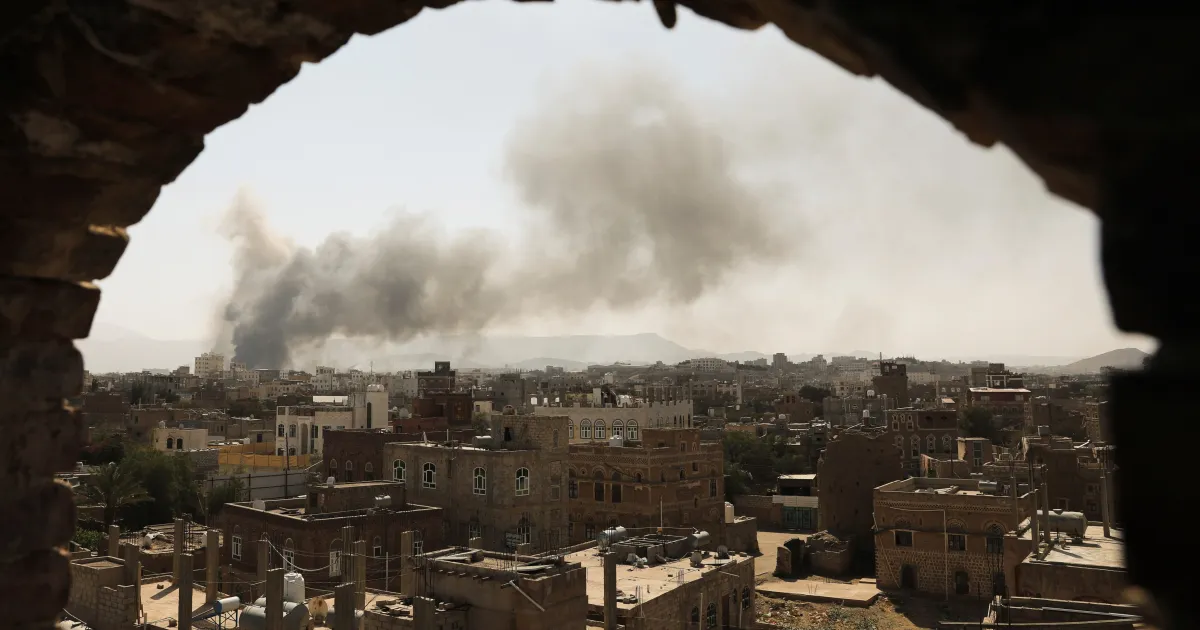
Yemen is witnessing escalating political and military developments amid growing demands from southern Arabs to declare an independent state. Southern governorates have seen mass rallies coinciding with announcements by 21 out of 24 ministries in the internationally recognized government declaring their support for the Southern Transitional Council (STC).
The partnership within the internationally recognized government—between northern and southern actors—was originally built around core objectives: confronting the Houthis and their Iranian-backed project in Yemen, as well as the Muslim Brotherhood allied with the terrorist organization Al-Qaeda. However, this partnership has entered a serious test following airstrikes carried out by the Saudi Air Force on positions belonging to the Hadrami Elite Forces in Hadramout governorate, according to Aden Independent TV.
The strikes targeted the Hadrami Elite Forces, which are government forces affiliated with the Southern Transitional Council and which successfully liberated Hadramout from Al-Qaeda in 2016. The Saudi bombardment came just hours after the Hadrami Elite Forces were ambushed by terrorist elements, following a large-scale military operation launched by STC forces at dawn on December 3 aimed at “liberating and clearing the cities of the Hadramout Valley and Desert from terrorist elements and Brotherhood-affiliated militias,” according to China’s Xinhua News Agency.
Hadramout is one of Yemen’s most strategically significant regions, lying along routes critical to global maritime trade through the Red Sea, which carries between 12% and 15% of international shipping—a vital corridor linking Asia, Europe, and Africa.
Yemen is currently divided into zones of influence: Houthi-controlled areas in the north, particularly the capital Sanaa; Muslim Brotherhood presence in parts of Marib; and territories administered by the internationally recognized government, of which the Southern Transitional Council is a central pillar, operating from the southern city of Aden.
The STC’s standing in Yemen has grown following its success in extending control over the southern coastline, major oil fields, and most of the territories that once constituted the former South Yemeni state prior to the 1990 unification. The Council has increasingly presented itself as a force capable of confronting security threats—chief among them terrorist organizations—particularly after recently launching security operations against Al-Qaeda cells and Muslim Brotherhood-linked militias.
The Timing of Saudi Strikes Cannot Be Read in Isolation
The timing of Saudi airstrikes on Lahj governorate, followed by attacks on forces affiliated with the Southern Transitional Council (STC) in Hadramout by tribal insurgents, cannot be viewed in isolation from the threat issued by Mustafa Noman, Deputy Foreign Minister in Yemen’s internationally recognized government. During an interview with a Saudi television channel, Noman threatened to ally with the Iranian-backed Houthi movement against the south.
Noman’s remarks sparked widespread anger on social media, particularly as they were made from within the Saudi capital, Riyadh. His attack on the Southern Transitional Council came despite the fact that the STC is a national partner within the Presidential Leadership Council in the war against the Houthis and terrorism aimed at restoring the capital, Sanaa.
Two days after Noman’s threat, southern forces in Hadramout were subjected to an ambush carried out by “armed groups operating outside the law, affiliated with the tribal insurgent Amr bin Habrish and an individual known as Salem Al-Ghurabi, while the forces were performing their duties to consolidate security and stability.”
A responsible source in the command of the Second Military Region in Hadramout stated that “this attack does not merely target a patrol, but represents a desperate attempt to obstruct the campaign to cleanse the plateau and the valley of pockets of terrorism and rebellion, and to drag the governorate back into a cycle of chaos and militias.”
The Yemeni News Platform had previously reported that Saudi Arabia summoned Sheikh Amr bin Habrish, head of the Hadramout Tribes Alliance, to Riyadh, coinciding with the escalation between his forces and the Southern Transitional Council. However, the nature of the arrangements with which bin Habrish would return from the Saudi capital was not disclosed.
The platform described bin Habrish as a tribal leader loyal to Saudi Arabia and opposed to the STC. His arrival in the Kingdom coincided with renewed clashes between armed groups loyal to him and STC forces in the Hadramout Valley. This development also followed Saudi Arabia’s demand that the Southern Transitional Council withdraw its forces from Hadramout and Al-Mahra, alongside Saudi sources signaling that Riyadh might compel such a withdrawal by force if the STC did not comply voluntarily.
In recent months, STC forces have succeeded—through a series of military operations in Hadramout, Al-Mahra, and Abyan—in forming a unified and realistic military and security force across southern and eastern Yemen. This force now serves as a strong guardian of the region’s oil and commercial gateway in a highly strategic area of the Middle East and the world at large, given its wealth of oil fields, facilities, and seaports located along global supply and trade routes.
Political Absence
Hours after the Saudi Ministry of Foreign Affairs issued a statement on developments in southern Yemen, Saleh Abu Awthal, head of the Al-Youm Al-Thamen Foundation for Media and Studies, stated that “any objective and rapid reading of the statement requires an understanding of the Saudi political mindset. What Riyadh and its allies in northern Yemen present as a ‘fair solution’ fundamentally undermines the southern national cause in a lethal way; it does not recognize the outcomes of the 1994 summer war, nor the reality of military occupation, but instead views the south merely as a human rights grievance.”
Abu Awthal added: “Saudi officials are living in a state of political absence, and a genuine blindness in how the Yemeni crisis is managed. If we examine Saudi management of the crisis since 2011—the year of the overthrow of Ali Abdullah Saleh’s regime—it becomes clear that it has been catastrophic in its outcomes. Iranian proxies now control most of northern Yemen, with the exception of Marib’s center and limited parts of liberated Taiz. Even these areas have become arenas of chaos and violence, fostering permissive environments for extremist groups: Taiz is mired in armed disorder, and Marib has turned into a fragile security zone.”
He argued that “the Saudi statement issued by the Ministry of Foreign Affairs completely ignored the accumulation of more than a decade of crises in the Hadramout Valley and Desert, starting with the vacuum of authority in Hadramout and Al-Mahra, passing through the security failures of the internationally recognized government’s forces, and culminating in widespread popular and tribal unrest. Riyadh has approached the Hadramout crisis from the perspective of crisis management rather than crisis resolution—by postponing internal issues and tying them to a broader settlement in which the Houthis would be a party. This is categorically unacceptable.”
Abu Awthal warned that “the most dangerous aspect of the statement lies in its demands: the withdrawal of forces, the handover of military camps, and the empowerment of the ‘Nation’s Shield Forces.’ These demands do not propose a settlement or shared administration, but rather a full return to the status quo ante, erasing the new realities on the ground.”
Finally, the head of the Al-Youm Al-Thamen Foundation explained that “Saudi Arabia has verbally acknowledged the southern cause in its statement, but conditioned its resolution within a comprehensive Yemeni framework—one that excludes a southern state or even self-administration. In practical terms, this means postponing and politically neutralizing the issue by fragmenting it into localized regional concerns within the south. This regionalist discourse is one that some Saudi officials do not hesitate to adopt, so long as the issue remains under a Yemeni ceiling, even if the current reality is rule by the Houthi “Velayat-e Faqih”.’ Simply put, Saudi policy no longer appears to be built on Yemeni consultations, but it has come to recognize a reality: as a pivotal regional power, it no longer possesses genuine or stable alliances inside Yemen. The Houthis are an explicit Iranian proxy, and Yemen’s Islah party is tied to the international Muslim Brotherhood organization, regardless of attempts by some of its factions to deny this.”