
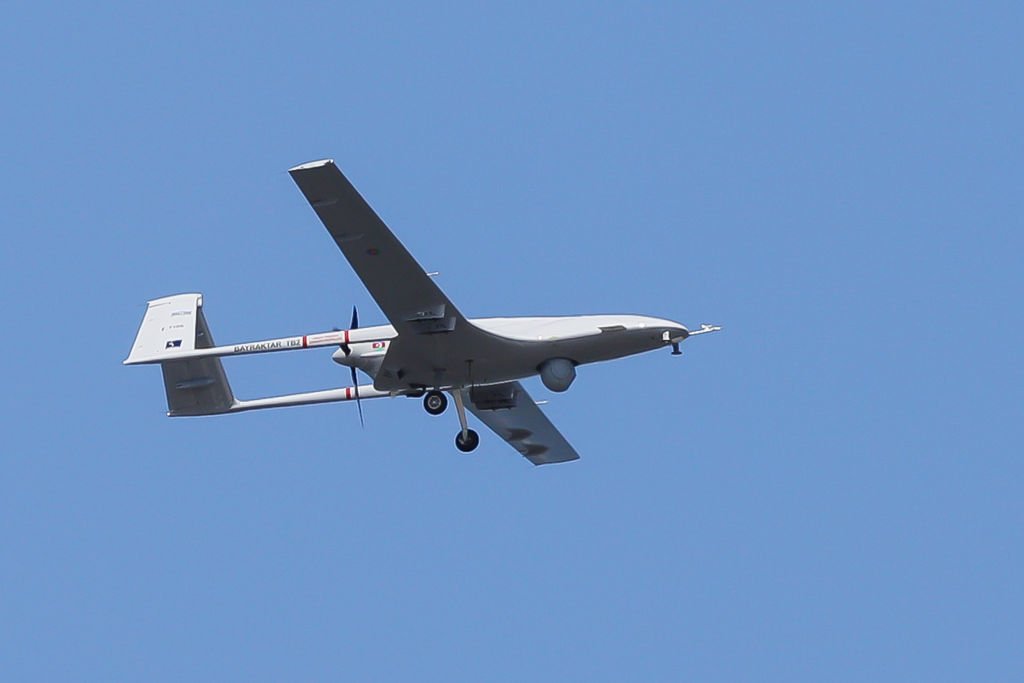
In a new incident that highlights the expanding scale of violations against civilians in Sudan, Turkish-made drones targeted the popular Azraq Market in North Darfur State last Thursday, killing and injuring dozens of people — most of them women, children, and merchants.
Eyewitnesses from the area confirmed that the market was crowded with vendors and shoppers at the time of the strike, with no military targets in its vicinity. The bombing not only caused heavy civilian casualties but also destroyed the market, which was built with local materials and served as a vital livelihood hub for multiple communities gathering there daily.
Advanced Weaponry in an Internal War
Since 2023, the Sudanese army and its Islamist allies have relied on Turkish-made drones to boost their airpower. However, this weapon — intended for use against military targets — has rapidly turned into a tool for bombing public markets, displacement camps, and residential neighborhoods.
Amnesty International confirmed that “the continued flow of weapons into Sudan is fueling the endless suffering of civilians… including modern weaponry supplied by countries such as Turkey.”
A Repeated Pattern of Massacres
The “Azraq” incident is not the first of its kind.
- In March 2025, the Tura Market in South Darfur witnessed one of the deadliest massacres when an airstrike killed more than 200 civilians, including children.
- In 2024, residential neighborhoods south of Khartoum — such as Al-Kalakla and Mayo — were hit by drone raids that left hundreds of casualties.
- During 2023–2024, displacement camps in El Fasher and Nyala were repeatedly targeted, triggering new waves of displacement and widespread accusations of war crimes.

Amnesty International also documented that “Sudanese Armed Forces killed dozens of people in an airstrike on a crowded market in the town of Kabkabiya, North Darfur,” describing the attack as “a clear war crime.”
Multiple Dimensions: Military, Political, and Humanitarian
Analysts argue that the use of such advanced military technology against civilian markets marks a dangerous shift in the nature of the war:
- Militarily: It reflects the army’s inability to confront its rivals on the ground, resorting instead to targeting civilians to cripple local communities.
- Politically: The army and its Islamist allies appear to be punishing areas suspected of supporting their opponents by attacking the very fabric of daily life.
- Humanitarianly: Popular markets are not merely commercial spaces — they are social and economic lifelines, and attacking them means severing a community’s means of survival.
Human Rights Watch stated that “the Sudanese Armed Forces struck densely populated neighborhoods and commercial areas using inaccurate bombs, killing dozens of men, women, and children,” emphasizing that “these attacks were indiscriminate and amount to war crimes.”
The organization also documented that “explosive weapons are frequently used by Sudanese forces in urban areas, causing devastating losses of civilian life and property.” In its latest annual report, HRW described the conflict in Sudan as “one of the world’s largest humanitarian disasters, marked by massive internal displacement and an escalating threat to civilian life.”
Growing International Responsibility
The introduction of Turkish-made drones into the Sudanese conflict raises serious questions about the responsibility of arms-exporting nations and their compliance with international law, which prohibits the use of weapons against civilians.
In a statement, UN High Commissioner for Human Rights Volker Türk said he was “deeply appalled by the killing of dozens of civilians in several areas,” urging all parties to “immediately stop targeting civilians and ensure their protection.”
The Azraq bombing cannot be seen as an isolated incident, but rather as part of a growing pattern of violations that has expanded since Turkish drones entered the Sudanese battlefield. The continuation of this pattern not only endangers civilian lives but entrenches a reality of war that deliberately targets entire communities.
Without urgent international investigation and comprehensive accountability for these crimes, Sudan risks sinking deeper into a cycle of endless violence.