

Sweden. Stockholm
Since the fall of Omar al-Bashir’s regime in April 2019, Sudan has spiraled into a vortex of political and security chaos. This turmoil escalated dramatically with the outbreak of civil war in April 2023 between the Sudanese Armed Forces (SAF), led by General Abdel Fattah al-Burhan, and the Rapid Support Forces (RSF), led by Mohamed Hamdan Dagalo “Hemedti.” What began as a power struggle has morphed into a multi-dimensional conflict, involving an ideological battle between Islamist and secular forces, entangled regional interventions—most notably, Turkey’s involvement.
This report delves into Turkey’s involvement in fueling the Sudanese conflict, tracing its historical roots, strategic objectives, and consequences for the country’s dire humanitarian and political crises. It relies on in-depth analysis supported by international reports, official statements, and expert opinions, with a focus on documented violations, famine, displacement, and the regional dynamics exacerbating instability.
Historical and Ideological Context of Sudan’s Conflict
The Roots of the Islamist-Secular Tension
The tension between Islamist and secular forces in Sudan stretches back decades. The Islamic Movement, led by Hassan al-Turabi, formed the ideological backbone of al-Bashir’s regime (1989–2019), which imposed strict interpretations of Sharia law. Over time, secular movements and armed groups, like Abdulaziz al-Hilu’s SPLM-N, increasingly opposed this system.
Although the December 2018 revolution toppled al-Bashir, it failed to dismantle Islamist influence within the military, sowing the seeds for a clash with secular civilian forces aligned with the RSF.
Dr. Suliman Baldo, Director of the Sudan Transparency and Policy Tracker, told the BBC in February 2024:
“The current conflict is an extension of an ideological struggle between a religious identity that sees Sharia as the state’s foundation and a secular vision advocating the separation of religion and politics.”
Turkey and the Islamist Movement: A Historical Alliance
Turkish-Sudanese ties tightened under al-Bashir, with Turkey’s ruling Justice and Development Party (AKP) forging close relations with Sudan’s Islamic Movement. In December 2017, al-Bashir signed a deal with Ankara to redevelop Suakin Island, raising concerns in Egypt and Saudi Arabia over Turkish influence in the Red Sea.
A Middle East Eye report from January 2023 noted:
“Turkey capitalized on this relationship to bolster its military and economic footprint in the Horn of Africa, leveraging Islamist networks within Sudan’s army.”
Turkish Intervention: Tools and Strategies
Military Support: Drones and Logistics
As the civil war intensified, Sudan’s army turned to Turkey to compensate for losses against the RSF. In September 2023, al-Burhan visited Ankara, and The Washington Post reported in October 2024 that:
“The visit resulted in a $120 million deal to supply the army with TB2 drones from Baykar, along with guided missiles.”
A Bloomberg report in December 2024 confirmed:
“Eight drones arrived in Port Sudan by November 2023, accompanied by a Turkish team to train the forces.”
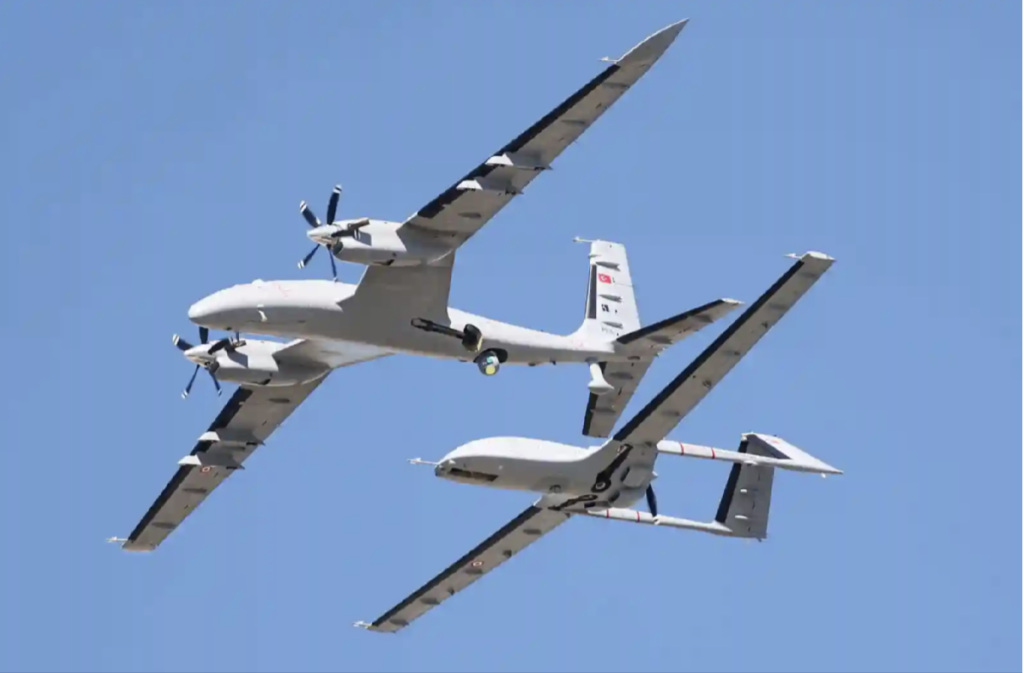
An image provided by Baykar shows a Bayraktar TB2T-AI UCAV armed unmanned aerial vehicle (UCAV) in Feb.
Violation of International Sanctions
This military support breached U.S. and European sanctions imposed on Sudan since 2021 to prevent escalation. The European Centre for Counterterrorism and Intelligence Studies (ECCSI) warned in November 2024 that:
“Turkey’s intervention undermines peace efforts and complicates the humanitarian crisis.”
U.S. Ambassador Robert Wood called before the UN Security Council in April 2024 for an end to arms transfers to warring factions, specifically citing Turkey and Iran.
Turkey’s Strategic Objectives
Turkey’s intervention aims to achieve dual goals: strengthening its Red Sea influence to counterbalance Saudi and Iranian dominance, and supporting Islamist forces aligned with AKP’s broader regional agenda.
The International Crisis Group noted in its 2024 report:
“Turkey sees Sudan’s army as a partner to safeguard its geopolitical interests, even at the expense of regional stability.”
Impact of Turkish Intervention on the Sudanese Crisis
Airstrikes and Massacres
Turkish support has significantly enhanced the Sudanese army’s air capabilities but led to unprecedented human rights violations. Sudan War Monitor documented in November 2024 that TB2 drones were used in bombing Omdurman, killing 49 civilians.
Human Rights Watch condemned the indiscriminate use of wide-impact explosive weapons in May 2023, while Amnesty International confirmed in August 2023 that drone strikes targeted hospitals and displaced persons camps, violating international law.
In December 2024, the army regained control of Al-Jazirah state with Turkish air support, but reports showed massacres in Wad Madani, with hundreds of civilians killed under the pretext of “cleansing the area.”
The Center for Information Resilience released videos in January 2025 showing field executions by pro-army militias, notably the extremist Islamist Al-Baraa bin Malik Battalion. This battalion, believed to receive direct Turkish backing, has increasingly influenced the army’s decision-making, particularly regarding war and peace.
Famine and Displacement
The conflict has worsened Sudan’s food crisis catastrophically. According to the World Food Programme (WFP) in February 2025, 25 million Sudanese face food insecurity. In Al-Jazirah state, airstrikes decimated agriculture, contributing to the displacement of 10.7 million internally and 1.8 million as refugees, per the UNHCR report from January 2025.
The Wad Madani Resistance Committee described the situation as “genocide” in October 2024, citing the collapse of infrastructure.
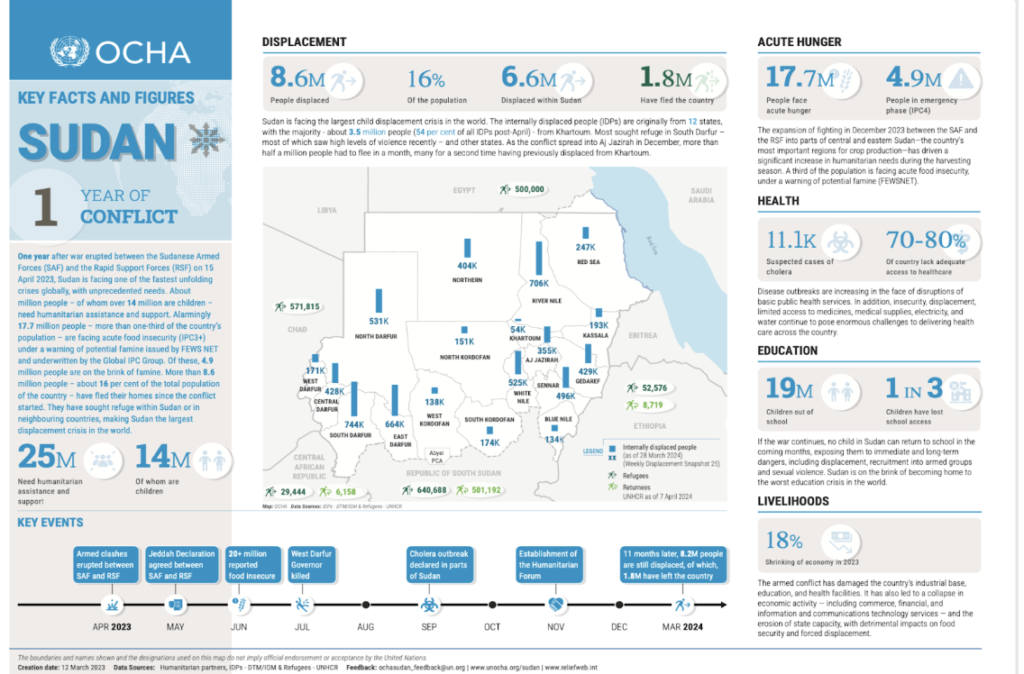
Sudan: One Year of Conflict – Key Facts and Figures – Infographic (15 April 2024) | OCHA
Deepening Ideological Divide
Turkish backing solidified the army’s and Islamists’ stance, pushing Hemedti to align with secular forces. On March 16, 2025, Hemedti called for a “secular state,” forging alliances with Abdulaziz al-Hilu’s movement, clearly drawing ideological lines.
Analyst Asmaa Al-Husseini told the BBC in October 2024:
“Turkey supports the army not just militarily, but as part of a broader Islamist project in the region.”
International Response and Peace Challenges
Global Condemnation
The United Nations condemned aerial violations, with Secretary-General António Guterres declaring Sudan in 2024 the “world’s worst humanitarian disaster.”
The U.S. imposed sanctions in January 2025 on Turkish companies involved, while the International Crisis Group urged accountability for indiscriminate bombings.
Army’s Rejection of Peace
Al-Burhan dismissed peace initiatives such as the Jeddah Talks (2023) and IGAD efforts (2024), stating on January 5, 2025:
“The RSF is unworthy of negotiation.”
U.S. envoy Tom Perriello told The Washington Post in March 2024:
“The army relies on Turkish and Iranian support to pursue a military solution, disregarding civilian suffering.”
Conclusion & Strategic Recommendations
Assessment:
Turkey’s intervention, via drones and logistics, strengthened the army’s capabilities but deepened Sudan’s humanitarian and ideological crisis. The massacres in Wad Madani, famine, and mass displacement highlight the failure of Ankara’s strategy to bring stability, instead turning Sudan into a theater of regional rivalries.
Recommendations:
- Strengthen the International Arms Embargo:
Support a comprehensive UN-supervised embargo to halt weapons—particularly drones—from reaching the warring parties. - Diplomatic Pressure:
Engage Ankara diplomatically to withdraw its military support, offering European economic incentives in return. - Support Mediation Efforts:
Back civilian-led peace initiatives and enhance the African Union’s role in negotiations. - Humanitarian Aid:
Establish safe corridors to deliver aid to Al-Jazirah, Darfur, and other regions across Sudan.